
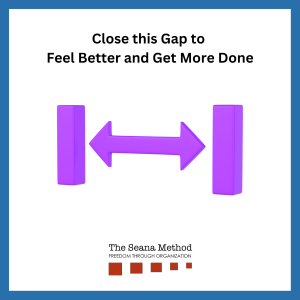
Years ago, I took a vacation to London. While there, I traveled via the Underground and was amused how each time we approached a station, a voice came over the intercom saying, “Mind the Gap.” This was a warning to pay attention to the gap between the edge of the car and the platform, lest I drop something or catch my foot in that space. Gaps can be tricky things to navigate, and not only in physical space. There is also an “inaction gap,” an interlude of time that can cause us to forget tasks or get stuck in inactivity. Here’s how to close this gap to feel better and get more done.
What exactly is the inaction gap? I define the inaction gap as the period of time between thinking of something you need to do and the time you actually start doing it. This gap emerges for a variety of reasons:
- You need time to figure out how to do the task.
- More urgent tasks require your immediate time and energy.
- Other people cause you to second guess your decisions.
- You get distracted.
- You don’t want to do the task and hence avoid doing it.
- You lack funds and/or resources to begin.
- You become ill and cannot proceed.
- You are plunged into a life event that changes your circumstances (e.g., a relocation, loss of employment, natural disaster, etc.)
Whatever the reason, the truth is that the larger the gap grows, the harder it will be to do the task. I liken this phenomenon to a watching a boat that you wish to board pull away from the dock. The further away the boat travels, the more difficult it is for you to embark. Why is this the case? Here are a few things that happen.
We lose momentum.
Getting started on a project or task requires activation energy. We need to rally our physical energy, focus, and determination to act. It’s like we are getting ready to run a race, kneeling in a starting block, setting our minds on the race, readying our muscles, and waiting for the starting gun. As soon as we hear the shot, we push off.
But what if the race doesn’t happen? What if there is a false start, or the weather changes and the race is delayed? Typically, our enthusiasm wanes and our adrenaline dissipates. It can feel harder to psych ourselves up again.
Many of the tasks before us are like a race, requiring that we summon commitment and expend energy. When we delay getting started, we risk telling ourselves, “Well, I can relax because I don’t have to do that right now.” Eventually, our energy can fade to the point where our perspective becomes, “I’ll get around to it sometime.” Periodically, we never get to it at all.
We rationalize further delays.
Many tasks are unpleasant, difficult, scary, confusing, or otherwise unappealing. These are the ones we tend to delay. Regrettably, procrastination tends to “feed the monster,” meaning it makes us feel more and more anxious about the task the longer we wait. Feeling anxious is lousy, so to soothe ourselves, we come up with a growing number of reasons to avoid the task longer.
- I can do this another time.
- This is stupid.
- I have more important things to do.
- I shouldn’t have to do this.
- First, I need a nap (or I need to clean, or do the laundry, or read this book, etc.)
Unfortunately, delaying action tends to add time pressure to an already stressful situation. For example, now, instead of having six weeks to complete a project, we only have two. Yes, I know there are some people who say that they work best when they are up against a deadline. If this is you, then you can skip this post! However, if you tend to spin on things that you should be doing, but aren’t, then realize that these excuses are like candy. They taste sweet now, but will undermine your productivity later.
Negative voices fuel self-doubt.
Stepping from the dock onto a boat can feel intimidating, especially to those who aren’t familiar with boating. Still, when the boat is literally next to us, it feels at least possible. We can make contact with the gangway, reach the handrail, and see where we need to step to get on board. In contrast, if the boat is a few feet from the dock, we quickly become full of reasons to avoid trying to board:
- It could be dangerous!
- I could end up in the water!
- I might catch my foot!
- I don’t think I can jump that far!
- I’m not sure if there will be a clear space to land if I leap!
These emotions are real, and the further away the boat gets, the more impossible this task seems. The reasons why we “can’t” or “shouldn’t” grow like an expanding balloon in our mind. Negative voices become justifications to avoid action altogether.
The Task Becomes Harder
In many cases, the task itself gets harder the longer we delay. As I said above, this can happen simply because the closer we get to a deadline, the less time we have to work. In addition, there are a plethora of other reasons why this may happen, such as:
- The supplies you purchased fall into disrepair.
- The parts or pieces you need are no longer available.
- The initial research you conducted is no longer valid.
- New technology has rendered your initial plan antiquated.
- You lose track of supplies because they get misplaced or buried.
- People who once offered to help are no longer available.
So, what do we do to close this gap?
The first step in solving any problem is to become aware that the problem exists. Therefore, I encourage you to keep the image of the boat pulling away from you front and center in your mind. When you have an important task to do, the goal is to work on it as soon as possible.
One simple approach is to try to complete in the moment any task that can be done in under two minutes:
- Run the item up the stairs and put it away.
- Make the phone call, especially when the call will give you a quicker answer than an email.
- Take the trash out as soon as you notice the can is full.
- File the document instead of stacking it.
- Hang up the coat rather than putting it on the chair to hang up later.
- Put the laundry in the hamper when you disrobe instead of putting it on the floor.
- Sort the mail when you bring it in instead of stashing it in a bin.
- Put your dishes in the dishwasher as soon as you are finished with them.
Of course, not all tasks are quick. Many of the tasks we procrastinate require significant time and energy. Still, the sooner we get started, the better. If you can’t see your way to the finish line of a task, get the ball rolling by doing something. For instance, if you have to repaint a room, the first step might be to gather some paint samples. Or, if you need to declutter and organize a space, the first step might be calling a professional organizer to come for a free consultation.
Whenever you realize that you are avoiding taking action, ask yourself how you can break the task down even further. The goal is to identify a step “small enough” that you will actually do it.
And remember, don’t wait to “feel ready,” just start. The boat is pulling away! The longer you wait, the more effort you will have to expend to get into the boat.
To be clear, I’m not pushing you to act recklessly or irresponsibly. Setting priorities is critical. Having a plan is valuable. However, you don’t always need a complete plan for how to get from A to Z. In many cases, you just need to identify, and then take, the next step. Taking one step is akin to pulling a boat’s rope back toward you. Making even a small bit of progress is empowering and reduces stress.
And then, you get up and take one more step the next day.
One final note: limit the number of boats you are trying to board. You can’t be in three boats at once. Yes, we all juggle multiple responsibilities, but sometimes we make life harder on ourselves than it has to be. Allow yourself to focus on one thing at a time. On any given day, most people only have bandwidth to work on one or two projects. The rest of the day is filled with recurring tasks.
It’s also harder to step into a boat when you are scrolling on your phone or thinking about other things. You have to let your brain focus on boarding to avoid falling in the water, so when you are ready to act, mercilessly silence distractions.
* * *
Have you ever struggled with the inaction gap? How did you close it?


Thank you for capturing all the ways that what is called “initiation” stalls. This executive function prevents real action. It can be easy to get discouraged because while you know what to do it’s hard to get started. You are so right that JUST starting is the answer.
Once you start the car moving, it is easier to steer. Here’s to starting!
I recently read a book called “The Worry Trick” which suggested imagining the very worst possible scenario might run into, exaggerate as much as you can, and then think of a way to deal with it in the unlikely event it happens. That way you’re more than well prepared. I tried it and it worked!
I love this idea. It provides a great way to move through and then beyond your worst fear. If you know you can deal with the “worst case scenario,” you feel empowered to step into the unknown. Hopefully, things go better than you think!
I love this analogy, Seana. Getting onto a boat can be tricky and the closer it is to you (the dock) the easier it is. You are echoing something I read the other day on Instagram from Mel Robbins. She was saying (I’m paraphrasing here) that there is never a perfect time or perfect circumstance to do something. And that you must have a clear understanding of your reason for having this item on your list otherwise it probably won’t get done. I have pushed a self-imposed deadline to complete a project back a few times now. One time it was because it was hard and I didn’t quite understand what I was doing. Another time was because other things took priority. Now, I’m down to the wire, if I want to have a finished product by a certain date, I must knuckle down and get it done. To your point about focusing on one thing at a time – this project is now my one thing. I’ll let you know when it’s done!
Good luck, Diane, as you focus on this one critical thing. The impending deadline and your strong desire to proceed will surely get you to the finish line.
Love that point about needing a clear understanding of the reason to pursue a task. It helps clarify your priorities. Stuff that feels unimportant is definitely hard to do, especially if it is unpleasant.
This is brilliant piece and such an important topic! That gap can derail action. I love your analogy about boarding the boat and not letting it get too far from shore. It makes it more challenging to board for a host of reasons.
The activation energy is something many of my clients struggle with, and for many of the reasons you explained. The longer they remain stuck, ruminating, doing other things, or postponing, the more difficult starting becomes in their thoughts.
As you mentioned, finding the next, least intimidating, and doable step helps. Each step becomes easier, but starting somewhere is essential.
I find the boat image helpful. What can I do to keep that boat from getting further away, or even to pull it back in closer? Can I just run and hop? The steps do get easier, just as it is easier to drive a car that is moving than it is one that is sitting still.
What a great topic! I especially liked the visual of the boat. I can feel that boat drifting farther away as I hesitate or look elsewhere.
Sometimes I get waylaid on a project because I am waiting for someone else to do something. I tend to just let things slide rather that reminding that person that their delay is affecting me. Sometimes that is just a miscommunication where the other person didn’t realize that I had a deadline in mind.
And like many of us, I have a multitude of projects or tasks, so I have to continually re-evaluate and re-prioritize.
I am a great believer in that if you can do it in 2 minutes or less do it now. Just this morning I was typing up my to do list for the week and one item I was going to type on would take less time to stop and just do it now than to type and print it on my list. ;0 So that task is done and my list is shorter.
Yes, I love that you just stopped writing the task down and did it. Beautiful. Satisfying!
That point you make about miscommunication is so important. Often we are engaged in projects where others are unaware of our timeline. Simply making that clear to all parties involved can really help keep things moving along.
So many good point here Seana. Best laid plans right! One of the gaps that drives me crazy is waiting for an answer, an email, a phone call, a text. I sometimes feel like my life is on hold until I hear from that person. And then there is waiting until the last minute to do a needed project. That can cause a lot of stress and sleepless nights. I sometimes do wait till closer to the date but it depends on what it is. I also like being organized and will work backwards using a calendar to plan something for the future.
Yes, that gap of “waiting” is always hard. You can’t move forward because your progress depends on someone else. That’s why it’s okay to have a couple of projects going, but in any given moment, it still helps to focus on one of them.
Great to start at the end and work your time backwards!
This is a stellar post, and boy, did I *feel* it. I rarely procrastinate on a task; I like to start, even with a baby step, as soon as I know about it, because it’s somehow easier to “go back” to a task that was begun than to know I have to start from the beginning.
Last week, I didn’t follow on my own rules; or, I should say, prior to last week. I’d watched all last year, waiting for the class action suit for victims of Kia thefts to finally be approved by the court. There was an application, but we were warned that until it was approved, everything could change. I should have at least peeked at the submission form to know what I’d need so I could have scanned all of those documents, but I didn’t. I kept putting it off, and then suddenly, it was due, and if I’d had everything scanned, I would have finished it off quickly. But I ran into a scanner problem which took all day (and ChatGPT, and a wow-I-coulda-had-a-V8 head-slap) to fix. It’s so rare for me to procrastinate, but this was a doozy and I’d put “Do Kia class action form” on my task lists week after week!
I’m a huge believer that activation energy is both real and smoke-and-mirrors. In the end, we just have to START DOING THE THING because only by starting can we get our engines revving. Until we take the first step, it’s all just in our heads and that inaction gap gets so big that sometimes, using your metaphor, by the time we jump, we’re going to end up splashing in the water.
So much wisdom!
I can hear the splash!
I can also completely reply the V-8 commercial in my head. That was a really great campaign. Remember when commercials were fun like that, instead of mostly being for pharmaceuticals with scary disclaimers?
The whole Kia nightmare you experienced was just awful. Technology always fails when time is short. I feel this comment under my skin. Been there. I hope it all works out and you get some reward.xox