
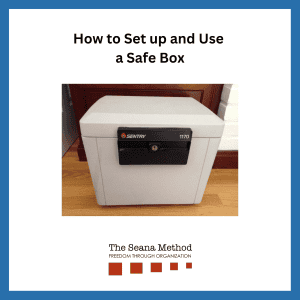
HHave you ever been part of a conversation that starts “If you house caught on fire, what would you grab before running out the door?” It’s a good question! Maybe you think of photos, love letters, or even your wallet. Of course, there is no wrong answer. At the same time, there are some documents that are tricky to replace, so having them safe and accessible is worth the effort. To ensure that you are in good shape in the event of an emergency, consider these tips for how to set up and use a safe box.
Step 1: Gather Your Contents
You may wonder what exactly should go into your safe box. The idea is to pull together anything that would be particularly tricky to replace. Fortunately, the emergence of cloud-based options has made it easier to store a lot of our most important information remotely. I highly recommend you backup your digital devices, preferably with at least one backup being in the cloud.
Nevertheless, you may have some physical items that you wish to preserve. These include, but are not limited to:
1. Original documents, such as:
- Wills and Trusts
- Passports
- Marriage License
- Divorce Decree
- Birth Certificates
- Baptism Certificates
- Citizenship and Immigration Paperwork
- Military Service Records
- Living Will
- Power of Attorney
- Social Security Card
- Homeowner’s Insurance Policy
- Life Insurance Policy
- Savings Bonds and Stock Certificates
- Mortgage
- Ownership titles (car/boat/cemetery plots/etc.)
- Diplomas
- List of account numbers, passwords, and logins (e.g., on an encrypted thumb drive)
- Adoption Papers and Court Documents
2. Copies of important items you use too frequently to store remotely, but would need to replace if stolen or damaged, including:
- Wallet contents (including fronts & backs of each card)
- Driver’s license (front and back)
- Passport (particularly the barcode on the back page)
3. Small/highly valuable/sentimental possessions which can’t be replaced, such as:
- Lock of child’s hair
- Favorite pieces of jewelry
- Photos and letters from a deceased loved one
- Small, high-value collectibles
4. Cash on hand.
In the event of a large-scale emergency or power outage, you may not have immediate access to your bank account. It is always a good idea to have some money for groceries and fuel if ATMs were to go down or travel were restricted. ($500-$1000)
Step 2: Choose Your Box
There are a couple of options when it comes to what kind of safe box you want to use. Each has pros and cons. Let’s consider each one.
Safety Deposit Box:
This is a box you rent at your bank. My friend Julie Bestry wrote a very thorough piece on safety deposit boxes, so check out her post for more information.
Pros:
- Well-secured (e.g., by cameras, alarms, etc.).
- Offsite, so potentially not impacted by a catastrophe that impacts your home.
- Confidentiality.
Cons:
- Limited accessibility, not open 24/7/365.
- Potential access issues (e.g., a power of attorney or court order if the box owner is deceased).
- Requires a trip to the bank to access.
- Ongoing monthly fee.
- Limited in size.
* Reminder: Just because you put items in a safety-deposit box does not mean they are automatically insured, the way your bank account is. Insuring valuables remains the responsibility of the box renter.
In-Home Safe:
These are safes that are installed into a home to provide extra security against theft.
Pros:
- Designed to be hidden from intruders (although not in every case).
- Not easily stolen (they tend to be either built in or very heavy).
- Easily accessible since they reside in the home.
- Come in a variety of sizes.
Cons:
- May not be fire/flood safe.
- May be expensive to install.
- Not portable to grab and go in an emergency.
Firesafe Box:
These are free-standing boxes which can be purchased at a home/office supply store.
Pros:
- Designed to provide protection from water and fire.
- Relatively affordable.
- Portable in an emergency.
- Come with a lock so more secure than a file drawer.
Cons:
- Vulnerable to theft since they are portable.
- Some are very small.
* A fireproof safe should be rated for at least 1-2 hours of fire protection (e.g., UL 350 rating) and ideally waterproof. Keep it in a discreet, secure location.
*
Not sure which safe box option is best your you? Here are a few questions to consider for the items you have gathered:
How often do I need to access this?
If you want quick access, a home-based option is better.
How concerned am I about theft?
If you live in a high crime area, a safety deposit box might feel more secure.
Do I live in a fire- or flood-prone location?
If weather is your primary concern, then the flood/firesafe is your best choice. (Many banks do not guarantee weather protection for box contents).
What’s my budget?
Do you want a one-time cost? How do you feel about ongoing fees?
A few additional thoughts on your safe box…
- First, it never hurts to keep multiple copies of important documents in various locations. For instance, maybe keep one copy in your home and keep another in a safety-deposit box or even in the home of a loved one. Even though a copy may not hold the value of an original, having a copy will make it easier to replace the original.
- As I said before, take advantage of encrypted cloud-based storage for what you can.
- Ensure you have established legal access for safety deposit boxes in the event of your passing. You don’t want your box to go into probate.
- Remember that “safe keeping” is not the same as “insuring.” It is wise to get separate insurance for high-value items, wherever you decide to keep them.
- If you go with the safety deposit box, be sure to keep an inventory of what you have inside. It’s easy to forget what’s in there!
- If you need further help figuring out what to include, and want something that might help family members take over for you if you become incapacitated, consider a product like the Nok Box. This box has checklists to help you know exactly what to include. It also offers a weather-safe option.
* * *
Do you have a safe box? Do you have any tips or warnings about using one?


Great resource! Because emergencies happen we must be prepared with our vital documents.
With all the recent weather events, this feels all the more important!
We don’t like to think about the unthinkable. And because of that, many of us are unprepared for emergencies like the one you described. However, with a small amount of thought and planning, that prep can make a stressful situation a little better.
My husband and I have many of these things in place, but we could improve our systems. Thank you for the reminder and for the great checklist of things to consider.
It’s always helpful to just rethink what you are storing. We had a big power outage here years ago that covered the entire northeast (you probably remember!) and that really got me thinking about the value of having a bit of cash on hand.
This is great advice. I also recommend putting the documents into some sort of easy to carry folio or binder system. That makes it easier to carry than a box. The folio can be put into a tote bag along with the small high-value collectibles and memorabilia.
I had not thought about putting cash aside. I will do that for myself.
Great idea to put things in a binder/bag. Ideally you don’t want to have to lug the whole safe box into your car!
I love your list! It will help me determine whether I need a safe box, based on what I have on paper and in the cloud.
There always seems to be something. Those things that come with a government seal are always hard to replace!