
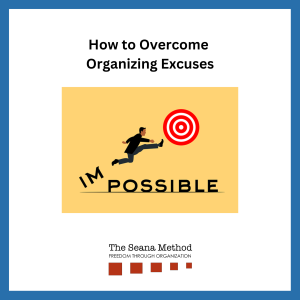
Getting and staying organized is an active “sport.” By this I mean, organizing isn’t something you do once and then never have to work on again. Living an organized life is better thought of as a discipline, like eating well or exercising. Unfortunately, many people find daily disciplines more challenging than one-off projects and often come up with reasons to avoid them. Fortunately, there are some strategies that can help you overcome organizing excuses.
The Truth About Excuses
First, let’s acknowledge a few facts about excuses.
- There is usually some element of truth in them.
- They make us feel justified in not following through on a previously identified goal or plan.
- They can become self-fulfilling.
- They don’t solve problems.
Excuses can feel good and wise in the moment, even though we often regret making them later. The key to overcoming any excuse is to understand why we keep using it and then create a plan to push past it in the future.
It is important to say that overcoming excuses isn’t easy. Patterns of thought and behavior are habits, and we often feel most comfortable in familiar routines. If you truly want to overcome an excuse, you need to be willing to make yourself uncomfortable. Think of the excuse as a hurdle that you need to jump over. Jumping isn’t easy, but with practice and repeated effort, you can get better at it.
Excuses & Strategies
Now let’s turn to some common excuses people use to avoid getting organized. For each excuse I’m going to consider:
- What is the element of truth in this excuse?
- Why does this excuse keep you from getting things done?
- What strategies can help overcome this excuse?
Excuse: “If I organize this space, it will just get messed up again.”
Element of truth:
Many aspects of life involve taking an action that may need to be repeated. For instance, we cook a meal, and then we eat it. We wash clothing, and then we wear and soil it. We fuel our cars and then use up the fuel. The fact that a task is impermanent, or might need to be repeated, doesn’t mean it isn’t worth doing.
The hurdle:
This excuse makes us feel like any effort we extend to get organized is a waste of time. Unfortunately, this excuse is disempowering. It makes us feel out of control of our own environment, and instead of pursuing improvement, we surrender.
Strategy:
To combat this excuse, reframe the way you think about organizing and resetting your space. Organizing is one of many tasks you repeat, like brushing your teeth, taking a shower, or even drinking a glass of water. Rather than feel like a defeat, there can be joy in conducting a daily reset.
If you feel like your efforts to create an organized living environment are being undermined by others, address this head on. Call a family meeting, sit down with your significant other, talk with your roommate. Among adults, aspects of daily living can and should be negotiated to the satisfaction of all involved parties.
Excuse: “I don’t have time to do this now.”
Element of truth:
Most people have more to do than they have time to do it. Rarely do I find someone who has sufficient time to pursue every possible organizing project at a leisurely pace. You may honestly be stretched between work, family, parenting, caregiving, volunteer work, and more. It can be hard to carve out time to get organized.
The hurdle:
Using a lack of time as an excuse is really evidence that you are failing to prioritize getting and staying organized. Despite the time crunch we all face, most people find time to do what they want to do. Odds are, lack of desire, lack of knowledge, and/or fear of failure may be keeping you from getting organized. You may also struggle with ADHD that makes focusing difficult.
Strategy:
Prioritize your organizing efforts. This will require that you schedule appointments to get it done. If you struggle to hold yourself accountable, or if you lack the skills, consider hiring a professional who can make the most of the time you have.
Additionally, identify what you will take off of your plate while you work on getting organized. Maintaining your system will need to be an ongoing part of daily life, but setting up systems will require dedicated time. What are you willing to sacrifice? Don’t expect to simply “add it in” to what you are already doing. Instead, try swapping out a current activity with an organizing one.
Excuse: “I don’t have any place to put things.”
Element of truth:
Space is limited. We might lack the ideal storage space to put everything away neatly. We may also be holding onto more than comfortably fits within our space. Not everyone has a walk-in closet, attic, or garage.
The hurdle:
The problem with this excuse is that it stops us from trying to put things away. We can see that our drawers and closets are full, and we let this fact stop us in our tracks. We blame the house for being too small, without considering whether we may be keeping too much.
Strategies:
First and foremost, you have to do the hard work of shedding anything you don’t use, need, or love. If letting go is hard for you, you might need the support of an organizer or another person to help you talk through the decisions. I’ll say this: I’ve been helping people for years, and decluttering gets easier the more you do it. It’s like a muscle. At first it feels heavy and might even leave you sore, but as you do it, the whole process feels simpler and the benefits become obvious.
Second, use every inch you have. Add hooks or racks to the back of your doors. Add shelves to cabinets where there is wasted space. Consider the space under your bed. Look up and see how you might be able to take advantage of vertical space (e.g., a shelf around the top of a child’s room to hold trophies). You may have overlooked storage spaces that could be put to use.
Excuse: “I have more important things to be working on than organizing.”
Element of truth:
All of us have important things to do. Some of our responsibilities are urgent, others are non-negotiable, and many are “I’d like to dos.” The question isn’t whether you have important things to do, but rather what is the true value of living organized? I believe getting organized provides a concrete and cost-effective pathway to improved quality of life. However, each person must decide for himself/herself whether or not they want to invest the time and energy to get their time, space, and belongings in order. No one can make this choice for another.
The hurdle:
Relativism is tricky. We can struggle to compare apples to apples. Some tasks have an instant payoff, while the upside of others unfolds over time. For this reason, we tend to overestimate the value of activities that produce a quick result. Furthermore, disorganized spaces don’t demand our attention as “loudly” as an employer or a needy child might, making that problem seem less critical.
Strategies:
One way to jump over this hurdle is by tackling a small project that provides a quick reward. For example, organize your junk drawer. This doesn’t take very long, and you will feel so good every time you open it up that you will want to do more.
Another idea is to work on a project that has been hanging over you for a long time. Maybe schedule a weekend to finally go through the box of stuff you inherited and have been avoiding dealing with. The relief will feel good, and again, encourage you to do more.
A third strategy is by hiring a professional to get you going. Having someone show up at your door, whom you’ve agreed to pay, will suddenly make getting organized jump way up on your priority list. It’s sort of like signing up for a class or paying a trainer. You may know how to do the push-ups, but you will be much more likely to do them if someone is standing there counting, “1…2…3…”
Excuse: “I’m tired.”
Element of truth:
I really hear and understand this excuse. Life is hard, and many of us are burning the candle at both ends. We are physically drained and feel like the last thing we have energy for is a decluttering project. We are often thankful to just get through the day.
The hurdle:
The challenge with energy is that it is limited. We all need rest, and if you are truly lacking sufficient rest, that should be your top priority.
At the same time, a true need for rest can be confused with boredom and/or lack of desire. We can lack the energy to organize but somehow summon the energy to scroll social media or play video games. Yes, some activities are restorative, and these are important! However, we can choose to use our time for things that neither restore nor refresh as a means of avoiding what we don’t “feel like” doing.
Strategies:
First, if you are truly short on sleep or rest, see what you can do to get the rest you need.
Second, schedule to work on organizing tasks at a time that works well for your natural body clock. Be realistic. If you are wiped out after work, this probably is not the time to plan to overhaul the garage.
Third, work in small bursts. For example:
- Review and organize one section of your closet each weekend.
- Declutter one kitchen drawer each morning or evening.
- Review 15 accumulated photographs or emails each day.
The idea is to keep the demand on your energy low, so you don’t find yourself making excuses not to follow through.
Finally, try setting an alarm to go off each day to work on your organizing task. You can also set a timer–say, for ten minutes–to limit your engagement. It’s much easier to start a task knowing you can stop in ten minutes than it is to think you can’t stop until it is “finished,” which could feel like a long time.
Excuse: “I can’t make decisions about what to keep and what to get rid of.”
Element of truth:
Decluttering decisions can be challenging. The relationships we have with our belongings can be quite complex, reflecting relationships, our sense of identity, aspirations, grief, and more.
The hurdle:
When we avoid hard things, we are subconsciously telling ourselves that we “can’t” do hard things. This simply isn’t true. The more we avoid things, the more intimidating they become.
Strategy:
When something feels difficult, the best strategy is to drill down on exactly why the task seems hard. For instance, is it hard because:
- You worry about letting someone down or making them angry?
- You fear making a mistake that leaves you with regret?
- You think you might get rid of something that you will need in the future?
- You don’t know if something should be sold?
- You don’t want to fill a landfill?
Each person may have different definitions of “hard.” The good news is, once we know what is hard, we have a clue on how to make it easier. For example, if we are afraid of donating something that might have value, we can find out what the potential value is and then make a decision with this information in hand. If we are worried about getting rid of paper we may need should the IRS come calling, we can consult an accountant to clarify what needs to be kept. If we don’t want to fill a landfill, we can research ways to plug our unwanted goods into the circular economy or to dispose of them in an environmentally friendly way.
Excuse: “I don’t have the time or energy to do it ‘right’.”
Element of truth:
Perfection is often unattainable. You may have an image in your mind of how you would like an organizing project to be, and yet you lack the time, funds, or know-how to make it happen.
The hurdle:
When we delay action until we can get a perfect result, we often take no action and end up with no result at all. Done is better than perfect. Furthermore, remember that you can always loop back and tweak a solution later if you want.
Strategy:
If you struggle with perfectionism, push to clarify what level of improvement would be enough to make you feel good about the result. Perhaps you can’t achieve a closet that looks like a magazine advertisement, but you might be able to get one where you have sufficient space to slide clothes around and see what you have.
Focus on progress, rather than perfection.
If you think you won’t be happy unless it is perfect, remember that you aren’t with the status quo either. Any improvement may lift your spirits and make daily living easier, which is a win.
Excuse: “I’ll do it later.”
Element of truth:
We can’t always work on tasks in the current moment. We must constantly juggle what has to be done now with what can wait until a future moment.
The hurdle:
This is the old phrase, “The path to hell is paved with good intentions.” The temptation is to keep delaying organizing initiatives indefinitely.
Strategy:
If you never seem to get around to organizing, you need to jumpstart your activation energy. You can see my advice for doing so here, which includes things like accountability partners, timers, tracking apps, and adding urgency.
Some people say, “I work best under pressure, so I’m going to wait until I have to do this.” This is basically an acknowledgement of a need for external accountability. This is true for many people, and not something to be ashamed of. At the same time, if this is you, consider whether the last-minute component leads to your best work, or simply triggers you to act at all. Perhaps you can add the accountability without the pressure to act quickly.
Excuse: “I don’t even know how to begin.”
Element of truth:
For many people, organizing and executive functioning don’t come naturally. This is not a character flaw, nor is it something to be embarrassed about. If you have no idea how to do it, you are in good company.
The hurdle:
This excuse becomes a problem when we think that a lack of knowledge and/or ability now means we will never be able to do it. This leaves us with a “why bother even trying?” mindset.
Organizing is a skill and, like any skill, it can be learned.
Strategies:
If you feel overwhelmed by the idea of organizing a space, help is available. There are a variety of books, support groups, apps, YouTube videos, and blogs to help you know where to begin and how to proceed.
If you’ve tried these DIY tools and are still struggling, you can hire help. Professional organizers are a compassionate group whose sole purpose is to meet you where you are and help you achieve your goals. Organizations like the National Association of Productivity and Organizing Professionals (NAPO) and Faithful Organizers offer directories where you can type in your zip code and find organizers near you. Many of us also offer virtual services.
* * *
Obviously, this is not a comprehensive list of possible organizing excuses. Whatever your excuse, getting organized will require that you choose a new response when the excuse pops into your mind.
I love this quote:
“Your system is perfectly designed to yield the result you are getting.” ~Dallas Willard
If we keep doing things the way we’ve always done them, we will get the same results we have always gotten.
Do you tend to fall back on an excuse when thinking about working on getting organized? Might any of these ideas help you move forward?


You have covered all the great “reasons” that people are being held back from getting organized. Each of your strategies will help people move forward and accomplish their goals. Thanks for sharing.
I think the “element of truth” is what makes us cling to these reasons, even if they aren’t serving us well. Hoping this helps people move forward!
What a comprehensive list of excuses! I think the ones I hear the most are ”I don’t have time to do this now.’ and ‘I’m tired’.” Many of the other excuses are subsets of those.
It’s really hard to convince someone – especially my ADHD clients – that it will really help them have more time in the long run if they force themselves to do just a little bit each day.
Thanks for the strategies. I especially like the setting of the alarm to do one small task.
It can be very hard to pursue any activity for which the payoff will only really appear in the longer term. That’s where having someone show up really helps. I find the alarm trick helps me when I’m not feeling it!
Oh my goodness! I have heard all these excuses and more. I love the way you crafted this piece acknowledging the hurdle and providing strategies to help someone push beyond the excuse they are using.
Also, it helps to think about ‘being’ organized instead of ‘getting’ organized. Organized is not a destination a person arrives at and then stays without any more work. Being organized requires on-going maintenance activities. Daily resetting spaces and most likely changing some long-time habits and routines.
Living organized truly is more of a lifestyle, right? Once you get in the habit, you wonder how you ever lived any other way!
I agree with you, the process of decluttering is like a muscle. The more you do it, the stronger your decluttering skill gets. Making decisions, refining what you keep by getting rid of unwanted things, and finishing decluttering tasks are separate skills that, over time, strengthen the entire process, resulting in less time spent decluttering. It’s amazing how strengthening these specific areas can speed up any decluttering process.
It truly is possible to get better at doing things, and to come to feel like the efforts are worthwhile. Excuses may have some truth in them, but that doesn’t mean we should give in to them!
Wow, this is really comprehensive! Some of the excuses fit with other activities too, so I think your strategies can probably be applied to other areas than organizing too.
Yes, the excuses for avoiding unwanted activities can be used for a variety of endeavors. The good news is, a strategy that works in one realm will probably work in all of them!
Love how this breaks down organizing excuses without guilt — makes it feel doable instead of overwhelming. The small habit tips really hit home and motivate me to start today.
“a true need for rest can be confused with boredom and/or lack of desire” — Now THAT’S an element of truth that puts the opening line of Pride and Prejudice, even if it’s not *universally* recognized.
I love the way you isolated each of these excuses not as invalid, but as small, uncomfortable truths being bankrolled by our psyches so that (without strategic intervention), they become bigger, self-fulfilling prophecies. I particularly love your final section, as yes, if we keep doing what we’ve always done, we’ll keep getting what we’ve always got (British)/gotten (American). We have the power to prevail, but we have to use that power for good (and the good of our spaces and our schedules).
That’s it, Julie. There are aspects of our excuses that are valid, but insufficient. They keep us stuck, when we could be finding ways to acknowledge the challenges, but still moving forward.