
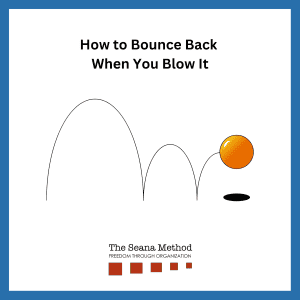
Have you ever blown it? I know I have. I think it’s fair to say that everybody blows it at one time or another. No matter the context, blowing it feels lousy. We feel ashamed, disappointed in ourselves, embarrassed, and more. Often, we struggle to resume our focus and try again. Here are some ideas for how to bounce back when you blow it.
Keep It in Perspective
One of the hardest things to avoid when we blow it is catastrophizing the error. By this I mean that we take one unfortunate action (or inaction) and project that onto our entire lives. For instance, we go from saying…
- “I lost my phone” to “I lose everything”
- “I was late for the appointment” to “I’ll never be on time”
- “I wasn’t able to fix this thing” to “I can’t fix anything”
- “That was a rough conversation with my child” to “I’m a terrible parent”
- “I burned the cookies” to “I can’t cook”
- “I missed my workout” to “I’ll never get in shape”
- “I indulged more than I should have” to “I just can’t control my eating/drinking”
It’s important to recognize that this tendency is driven by emotions. As I’ve said before, emotions are important to human life, but they aren’t great for productivity. Emotions are normal and need to be felt, but then they are best tucked away in our “caboose” rather than our “locomotive.” Admittedly, this isn’t always easy to do, but it is a habit you can cultivate. Click here for some tips on how to keep your emotions from hijacking your day.
Remind yourself that one situation or circumstance doesn’t define you. One bad play doesn’t lose the game. You will get a chance to try again, and you need to remind yourself that next time, you can do better.
If you find yourself repeatedly blowing it in the same manner, you probably need some help to find a new path. Now more than ever, help is available. Don’t be afraid to confide your weakness to someone who cares about you and ask them to help you find resources to move forward.
Don’t Further the Damage
When we blow it, we should avoid making the situation worse. This may sound obvious, and yet it is worth saying because we often do this.
Here are a few examples:
- We overspend when shopping. Instead of ceasing the behavior or returning items, we figure “I’ve already messed up, so why stop now?”
- We make a snide comment in frustration or to get a laugh. The other person’s reaction shows they’re hurt — but instead of apologizing right away, we defend ourselves or say, “I was just joking. Why are you being so sensitive?”
- We let things go in the house for a week, and instead of restoring order, we just add more to the piles.
The best thing we can do when we blow it is to stop the bleeding. After all, if we were to go out in the morning and discover that our car has a flat tire, the last thing we would do is run into the house, grab a knife, and go slash the three good tires. Our goal when we blow it should be to stop the detrimental behavior– to fix the tire and keep moving.
Don’t Quit
The next step in recovering from blowing it is to keep yourself from quitting. When we are feeling down and out, we often struggle to rally forward. It’s understandable to want to just give up. The problem with quitting is that doing so sabotages our self-confidence. We are teaching ourselves that we can’t overcome, that we cannot succeed, that we really are no good.
There may be many things in your life that, at one time or another, you feel like quitting. Sometimes we may need to take a break or mindfully walk away. But simply quitting in the heat of the moment is a surrender. Perseverance is the “secret sauce” of productivity. Remember that showing up day after day does not mean giving 100% every day. No one can do this. When my children were babies, I never felt that I had 100% to give because I was chronically sleep-deprived. We all have good days and bad days.
Tenacity means you keep going, even when you are a bit compromised. Even when you’ve blown it the day before. Even when you feel inadequate, lacking, deficient, unqualified, unprepared, and otherwise insufficient.
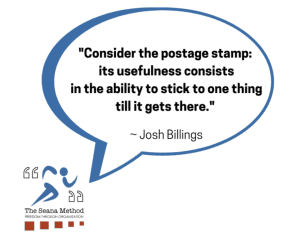
It isn’t about being perfect, it’s about not quitting. As I said before, one bad play doesn’t lose the game. You know what loses the game? Quitting. If you give up on yourself, you cannot win. If you miss the shot, go for the rebound.
Cultivate Bouncebackability
The other day I heard a great term that was new to me: “bouncebackability.” This term is credited to Iain Dowie, a former UK football(soccer) manager, who used the word during his time at Crystal Palace covering the 2003-2004 season. During this season the team went from near relegation to earn promotion through the play-offs. A true “come from behind” success story.
I love this word, and everything it represents.
First, we wouldn’t need to bounce back if we had done everything right. The word acknowledges that we have messed up in some way, and the result is that we aren’t where we want to be. It meets us where we are.
Second, bouncebackability represents potential for improvement. It says, “Not only can I try again, but I can also do better next time.”
In my opinion, bouncebackability is as important– or maybe even more important– than almost any other skill in life. Why? Because it can be applied so widely. Bouncebackability is resilience. We can tap into it anytime we’ve blown it. Since we know we will blow it over and over, bouncebackability is going to come in handy!
How can we cultivate bouncebackability?
1. Redefine what failure means
Most of us see mistakes as proof that we’re not good enough. But resilient people treat failure as information — not identity.
2. Strengthen self-compassion
We bounce back faster when we treat ourselves like a friend, not a critic. Replace “I’m so stupid” with “I made a mistake, and I’m learning.” Imagine what you’d say to someone you care about in your situation — then say it to yourself.
3. Stay connected
Resilience is rarely a solo act. Community helps us remember we’re not defined by one bad moment. Even asking for small help (“Can you remind me I’m not a failure?” “Can we talk about a struggle I’m having?”) can change the recovery trajectory.
4. Make a bounce-back plan
After a setback, ask yourself, “What’s one small thing I can do to move forward today?” Tiny acts of control — tidying your space, exercising, writing an apology, sending one email — rewire your brain from helplessness to agency. Progress, not perfection, rebuilds confidence.
5. Remind yourself of past successes
In the moment, it’s easy to think you can’t bounce back. This is not true. You are here today, which means you’ve bounced back before. Remind yourself of previous times when you’ve shown resilience:
- “I got through that breakup.”
- “I survived that awful week at work.”
- “I thought I couldn’t get through that, but I did.”
- “I let my child down, but she forgave me – and I came through the next time.”
* * *
Can you think of a time when you really blew it? How did you respond? Will you do anything differently if it happens again?


Love the word ” bouncebackability”!
I’ve always felt that I have tenacity – sometimes maybe too much. I think sometimes people do what I want them to do just to stop me from going on about it. 🙂
Keeping on keeping on and asking for help or advice is what usually gets me going again when I feel that I have not done well.
Thanks for the great reminders!
Just keep going, right Jonda? Asking for help or advice can really be a great way to bounce back!
This is great stuff, Seana! I am all too familiar with the tendency to overgeneralize when something goes wrong and can identify fully with the examples you gave. I especially like your reminder not to treat ourselves worse than we’d treat a dear friend.
We always seem to be hardest on ourselves. It just doesn’t help any situation. Learn and more forward!
Great information to keep in mind. Especially for perfectionists like me. I love the postage stamp quote!
That quote “stuck” with me too!
I recently listened to Mel Robbins’ podcast, and according to experts, tenacity is the real key to bouncing back. I see this often: It is easy to be frustrated and quit. Happily, if you persevere sometimes, that is the key!
I completely agree. Just keep showing up and your potential is amazing!
Bouncebackability is a great (and fun) way to look at resilience. The instinct when you blow it can be to blow it all UP or quit, and neither is productive, whether you’re talking about your diet and good habits or preventing bad habits.
I love how you spelled out the ways of strengthening the bouncebackability muscle, because some people had that flame extinguished in childhood or in bad relationships. Giving people the tools to built it up is so empowering, and you reminding people that they can rope in others and develop a plan for anticipated difficulties reminds them that this is not a one-and-done issue. This was so uplifting!
Loving the point you made about some people having had their bouncebackability damaged in childhood or in a bad relationship. Those words and/or scripts can keep running in our minds and really hold us back, even though they are probably categorically untrue!