
The concept of minimalism has been around since the 1960s. While often associated with stark spaces and extreme lifestyles, minimalists claim it has many benefits. About six years ago, a couple of fellow professional organizers and I formed a group called “Minimal Quest” as an open forum to explore minimalism and how it intersects with organizing. While none of us identify as minimalists, we find the idea intriguing and enjoy meeting up virtually on the third Tuesday of the month. This past Tuesday was a particularly fun meeting where we three professional organizers shared thoughts on how choosing less results in a life of more, particularly as it relates to having more time. Here are the highlights.
I kicked off the session by providing an overview of how having “less” might translate into more time. I shared a story about how I ended up, by a strange alignment of circumstances, on a vacation at the New Jersey shore with my father, my two little children, and my sister’s two little children, for a week. The first day my father and I dragged every item we had brought down to the beach, including:
- 6 chairs (one for each of us)
- A large/heavy beach umbrella
- A large bucket of beach toys
- 6 towels
- Snacks and water for all of us
- Sunscreen
If you’ve ever been to the Jersey shore, you know that the beach is quite large, requiring a bit of a walk to get over the dunes and down to the water. On that first day, by the time my dad and I got down to the beach, set everything up, and applied sunscreen to the four children, we were not only exhausted, but didn’t have much time before we would need to head back for lunch.
We quickly revamped our approach.
By the end of the week, we had a new plan:
- Sunscreen would be applied inside before we left for the beach
- Each child was to carry her own towel, snack, and whatever toys she might want
- We wouldn’t bring chairs for the children (they never sit in them)
- My Dad and I could live without an umbrella
With our slimmed down operation, we had a much lighter burden and more time in the sun (which happens to be a priority for my Dad and me!).
The point of this story is that in many cases, less truly does result in a better quality of life. Consider this little graphic I shared.
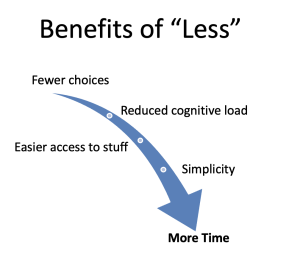
When we have less stuff, or fewer items on our calendar, we enjoy several benefits:
- We have fewer choices. This can be a plus, since choices can overwhelm us. If you’ve ever shopped for yogurt or nail polish, you know what I mean.
- Cutting down our choices reduces the weight of decision-making on our minds, sometimes called our “cognitive load.” For example, it is easier to select a paint color from three swatches than from 30 versions of what feel like the same color.
- Having less also means we are likely to have an easier time storing – and accessing – our belongings. Have you ever tried to stuff a coat into an already packed closet or to open an overpacked utensil drawer?
- Managing fewer items is simpler. If a child has only a couple of toys, reset time will be a breeze. If he has a room overflowing with toys, he may balk at the idea of putting things away.
- All of this leads to having more time, money, and freedom to focus on and enjoy what matters most.
This is not to say that we should be getting rid of objects that we need, use, and/or love, only that we might want to mindfully and intentionally eliminate items that are distracting from, rather than adding to, our quality of life.
After this overview, I then shared with the group examples of where I have intentionally chosen to “live with less.” Are you curious? Here were my examples:
I Eat the Same Breakfast and Lunch Every Day
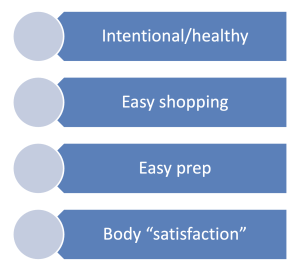
Some might find this to be boring, but I actually love it. I’m not rigid about it; if I’m out with friends or at an event, I’ll eat something different. But for my day-to-day life, I have made a choice for what I want to be eating for breakfast and lunch. Being intentional about this choice means that I am eating something fairly healthy. It has also translated into easy food shopping (I know what I need to get) and quick meal prep (I could prepare these meals in my sleep). I’ve also been surprised to discover that eating the same things for breakfast and lunch has somehow translated into my mouth “wanting” these foods at breakfast and lunch time. I will also admit it seems to agree with my digestive system, which is a nice side benefit.
I Only Have Three Credit Cards
When I was growing up, it was popular to take out store credit cards to “get an extra 15% off your purchase today.” I think many stores still make this offer. It seems wise on the surface, but over time it can lead to a lot of credit exposure.
My family has chosen to use only three credit cards. Using the same cards has allowed us to focus on acquiring “points” in a concentrated manner. Additionally, it has simplified bill paying, because we don’t have a lot to keep track of. Honestly, we probably would only have two cards, but at one point I had to get a VISA card to use at Costco.
“No” New Apps
Back in the early days of apps, I would download any app that I heard about. Over time, I’ve become pickier. I don’t like having tons of apps on my phone, and I’m not a fan of the folders on my home screen (probably because my vision has worsened over time).
In general, I have to either really need an app for a specific purpose or it has to come highly vetted and recommended. I’m very cautious about anything that requires a username and password. I’m tired of usernames and passwords.
If I do need to download an app for a specific experience, such as when I wanted to hear the audio tour of The Breakers Mansion in Newport, RI last summer, I don’t let it hang around on my phone too long. I enjoyed the tour, and then deleted the app.
“One” Set of Sheets
I put the word “one” in quotation marks because I actually do have two sets of sheets for my bed, but I really only use one at a time. One set is for summer, and one set is for winter. I really don’t enjoy spending time folding sheets (although I do know how). As a result, I simply take the sheets off the bed, run them through the washer and dryer, and put them back on.
I do this for all my beds. If I were to need my second set (e.g., if someone were sick or there were a spill), I do have one. I take a similar approach with my towels.
One Good Knife
Every year, usually around the holidays, I start seeing the commercials for various gadgets. There are choppers of various sizes and shapes, but I prefer to just use my good knife. A good knife that you regularly hone and sharpen can take care of my cutting needs just about as quickly as the space-consuming gadgets. Admittedly, I do have a food processor should I need to do a lot of chopping for a large meal, but I rarely use it. It’s so quick and easy to just pull out my knife. It’s also quick to clean a knife, which can’t be said for many of the various chopping devices on the market.
Very Few Books
I love reading. I usually have at least two “for fun” books going at a time. In recent years I’ve really taken to audio books, and can get almost anything I want via the Libby or Hoopla apps on my phone (yes, these were worth it to me!).
Periodically, I will be part of a book group or class where I need a hardcover book. For instance, right now my church is reading through John Mark Comer’s Practicing the Way. So for a period of time, that book will be on my shelf. At the same time, I don’t tend to hold onto very many. I’ve saved some favorite children’s books, and there are a few I might read on hand, but it isn’t really very many.
I can always download almost any book to my Kindle for less than the space is worth to me.
One Travel Mug
Do you have a kitchen cabinet overflowing with travel mugs? Or do you stop at the coffee shop every day? As with my breakfast and lunch, I wanted something predictable and easy. This is the travel mug I use:
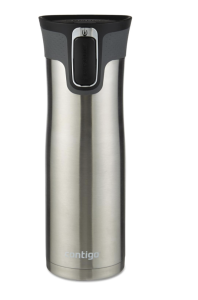
I have to say, I love my travel mug. I’ve been using it for many years. It locks well and is easy to drink from when I’m in the car (which is a lot). This mug doesn’t go in the dishwasher, so I just wash it out every evening and it is ready to go the next day.
I do have some travel mugs in my cabinet, but they are mostly kept up high for those times when I have guests. I don’t have to think much about coffee: I set it up in my pot the night before, press the button when I get up in the morning, and put it in my travel mug if I’m heading out. Almost no thought required!
* * *
After I shared my “less stuff, more time” examples, I turned the session over to Susan Lovallo of Clutter Solutions LLC. Susan suggested one of the easiest ways to minimize your stuff is to keep it from entering the door in the first place. This isn’t always easy to do. We understand, and professional organizers work with families who struggle with this situation all the time. Susan talked about the hurdles to having less that she called the “Overs,” namely:
- Over buying. Such as when we go to Costco and come home with large quantities of stuff we really don’t need, or when we are tricked into buying more than we need with “buy one-get one” offers.
- Over saving. We can struggle to recognize the useful life of an object and end up keeping items too long.
- Over in-case-I-need-it-someday thinking. There are some items that are wise to have on hand, and some documents that are important to keep. Still, we can fall into the trap of allocating too much of our space, time, and mental energy to items that are not currently enhancing our happiness. Many people hold onto items they don’t even like.
Susan reminded us that a beautiful home starts with an organized home, which can be hard to achieve when there is an overabundance of stuff. To help reduce the quantity, she suggested we consider the “Unders,” which include:
- Under decorating. Feng Shui suggests that on every shelf we have enough space to fit one teacup between items. Display areas with breathing room are more appealing. If you haven’t looked at your display spaces with fresh eyes recently, this might be an easy place to start!
- Under membershipping. Whether intentionally or not, many of us have signed up for services and memberships that we don’t really need. At minimum memberships cost a fee. At their worst, memberships tempt us to spend money acquiring products we don’t really want. When is the last time you looked into the number of memberships you have? Might there be a few you can trim?
- Under unpacking. Have you ever heard of “DOOM?” This stands for: Didn’t Organize, Only Moved. Might you have boxes from a previous move that you’ve never examined? It’s a common scenario. It’s also a potentially ‘easy hit’ for decluttering.
* * *
Next up was Matt Baier of Matt Baier Organizing. Matt shared his thoughts on how to navigate into a “less stuff, more time” life. Matt began by pointing that spontaneity is a gift of less. It’s hard to be spontaneous when we are weighed down by burdensome things, thoughts, and responsibilities. In contrast, when we limit our “stuff” to things that matter most, we will naturally gravitate toward experiences that center around our top priorities.
To minimize stuff and maximize time, Matt suggested:
- Look to small places for bit time gains. Matt gave an example here of how he previously logged every receipt into his check register. In contrast, now that he can access his bank statement whenever he wants online, he decided to stop this practice, recording only critical purchases (e.g., online bill payments, estimated taxes, etc.). The result has been an average savings of 20 minutes each week.
- Turn to tech to maximize time. Matt’s example here was transitioning away from paper books and toward digital reading. He can now download and read books on his phone, iPad, and Kindle at any time, all of which are synced so he doesn’t miss a beat.
- Limit your thinking and the pressure to make choices. Matt talked about how he has intentionally limited his wardrobe to an amount that comfortably fits into his closet and drawers. He has one type of clothing he wears for work (most days), and then a few options for non-work outings. He referenced others who made very limited clothing choices, such as Steve Jobs, who famously wore black turtlenecks every day. Matt admitted that this may be easier for him than it might be for women who have more complicated clothing needs, but he enjoys not having to spend much time thinking about what he will wear.
- Be intentional with structure choices. Matt talked about how we store items in the same way that we saw them stored growing up, even if that method is no longer serving us well. His example was using binders for financial statements. Back in the day, statements were mailed out pre-punched with three holes. The three holes made everyone feel that they should store them in binders and hold onto them. While this may have been helpful in the past, times have changed. Digital statements can be downloaded, and old statements can either be scanned into digital format, or perhaps discarded altogether. It’s no longer necessary to automatically keep paper. Likewise, we may be in the habit or storing items in a way that actually isn’t working very well. If you feel like you are spending a lot of time putting something away, consider whether there might be a better approach.
- Limit your choices. Like me, Matt talked about the benefits of limiting choice. His example was having only three mugs, each designated for a specific type of warm beverage. As with my travel mug, this makes life easy for him. Mugs are easy to wash, so he likes having what he needs without the burden of managing more than he wants.
- Remember that a clear runway gets you where you are going faster. According to the National Soap and Detergent Association, 40% of housework can eliminated simply by decluttering. We professional organizers aren’t sure if this statistic is accurate, but it certainly makes sense. It’s a lot easier to restore order and clean if surfaces are clear. Whenever possible, clear your surfaces.
* * *
For a post on less stuff, more time, this one was kind of long LOL! However, I hope reading this has given you some ideas for how intentionally choosing less might improve your quality of life.
What might you release in order to have “more?”


I love these real-life examples of how having less really means living more. I have recently realized it takes more than being intentional to live a life with less. There are so many ways to over-purchase with a simple click. Many people are especially over-extended on their time commitments with no time to rest, think, or be. Capacity and pace are especially important to think through post-covid. Thank you for these valuable insights.
Very hard to protect our time, and yet we are the only ones who can do this important task. No one else will step in and limit our commitments. In fact, others are likely to pressure us to take on more. It’s a great muscle to strengthen, the one to say “no.”
There are so many excellent insights here—chock-full. Once again, there is a connection between our posts this week. I didn’t focus on minimalism. However, I wrote about letting go of what’s no longer needed to create more joy, ease, space, and time for what you do want in your life.
I loved reading about how you each practice having less to live more. While I’ve made a lot of progress on this front, I have more to do. I’m looking forward to simplifying and paring things down further. I recognize that just because I have the space to store something doesn’t mean I need to keep it. That’s especially true if I no longer use or need it.
I’m also trying to work more on living with less. I had a gathering of the Faithful Organizers from the northeast at my house for lunch on Saturday. We all talked about how, when we come home from working with clients, we have an urge to get rid of some of our own stuff. Sort of a “me too” moment in our conversation.
Not everyone who lives in my space shares this vision (wink, wink), but I’m working on it!
This was fabulous and fun to read, Seana. You’ve talked about this group before. I love the way you get together and share thoughts. When Jonda Beattie and I wrote the Mission Statement for our business Release Repurpose Reorganize one the things that struck us was that when you have less, you spend less time caring for it (dusting, vacuuming etc) and have more time to spend doing the things that bring you joy. Here’s a copy of our statement: Our mission is guiding you to build your refuge in the world. To release, repurpose and reorganize what you own so it serves you instead of you serving it.
What a beautiful mission statement! The word “refuge” really resonates. That is what we all want our home to be, and yet so often, it becomes a burden, or a source of shame, or a stress point. The beauty of letting go is that anyone can do it. You don’t need a big budget or huge blocks of time. Like with your deck of cards, it can be done in 10 minutes a day!
Lots of great tips here! I also eat the same breakfast every day (varying only the type of fruit, but even those selections are limited) and we have two or three go-to lunches that we alternate. And I can absolutely confirm that having fewer outfits to choose from makes it a lot easier to get dressed!
Simplicity turns out to be a secret sauce for joy. What a great discovery!
I read this while eating my PB&J, which I have for lunch every day. (Both times I went to Europe, I realized two weeks with out my PB&J is just too long!) I also eat the same thing for breakfast and lunch every day (though I do switch out the fruit/side at lunch depending on my mood). Not having to expend mental energy on that choice frees up keeps in flow much longer.
I loved all of these examples and agree with most of them. But I will never give up keeping a check register (even though I don’t write checks). Yes, I can see that I just deposited a payment or bought mozzarella sticks thirty seconds ago by looking in my bank app, but actively keeping my register keeps me mindful of when, how, and on what I’m spending. (It’s like keeping that Weight Watchers food diary.)
I follow almost all of the practices you listed. I rarely buy anything that isn’t a consumable, so there’s little here to clutter things up. But packing for a trip is another matter. I never want to be “without” when traveling, and almost nothing goes unused. I’m just a little high maintenance when I’m not in my own nest. 😉
And you reminded me that it’s time to check my iPhone apps and let go of what I haven’t been using!
I can understand wanting to make sure you have what you need when traveling. When we are “out of our own nest,” we can’t necessarily easily acquire what we need. I am the same way when traveling.
I think both of my daughters eat peanut butter every day. It’s hard to beat, right? Easy, quick, affordable, high protein, and no refrigeration required!
You are preaching to the choir! LOL.
I have slowly moved towards minimalism. Like you, I eat the same thing most days for breakfast and lunch. I only have two credit cards (and the second one is just in case I lose the first one). It makes it easy to keep track of purchases. People don’t think about the amount of decisions you can avoid making with minimal living and it sure saves a lot of time.
That’s exactly it, Janet. Why force ourselves to make a lot of decisions that we honestly don’t need to make?
This is so good. I like to say I am a wanna be minimalist but not sure if that is really true. Sounds like a fun group. There are some really good examples and tips here that make so much sense. I love your beach experience. So relatable. I feel inspired to look around and make some decisions about my stuff. I am totally all about the simpler the better that is for sure.
The older I get, the more simplicity and predictability appeal to me. I don’t want to be wrapped up with having to make copious numbers of choices and decisions if I can free up time and mental space and be just as happy – if not more so!
I keep wondering what it is that you eat for breakfast and lunch almost every day!
I’ve been burning out on meal planning lately, and some version of this might help, I think.
For breakfast I eat berries, greek yogurt (plain), and an English muffin with decaf coffee and water. For lunch I make a wrap with these lavash wraps I get at Costco, turkey, spinach, tomato, and a slice of cheese, along with chips, and usually a Diet Pepsi and water. Inspirational? Not sure, but happy to share!
Sounds good, thanks!