
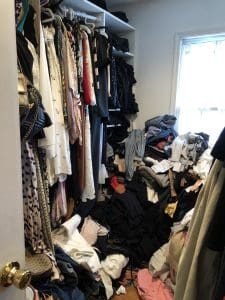
I love a closet. Organizing a closet can be one of the most rewarding tasks in a home or office. Not only does an organized closet look good, it also saves time and improves efficiency. On the flip side, closets can be dark and sometimes have spaces that are difficult to access. Furthermore, they never seem to be big enough. Many times we shove and stuff to get items to fit inside, and as a result, they can easily get out of control. If you dread the idea of organizing this important storage space, here is an easy approach for how to tame your unruly closet.
Step 1: Plan Your Organizing Session
How long it will take you to organize your closet will depend on how big the closet is and how much time you have. A large, walk-in closet will probably take a couple of days. A hall closet or linen closet can probably be organized in a couple of hours.
Be realistic in deciding how much to take on at one time. If you only have an hour or two per organizing session, you may need to work on only one section of your closet at a time . For instance, one column of shelves or hanging rod one day, another column or hanging rod another day. You can opt to work on consecutive days, or set aside one day a week to work on your closet. The key is to commit to working through the entire space until it has been completely reviewed and organized. You don’t want to clear space in your closet by creating a stagnant mess somewhere else.
Step 2: Gather Supplies
- A “staging” space where you can spread out and review items that you bring out of the closet. (e.g., a bed or table) – these jobs are easier if you don’t have to keep bending over.
- A step stool – handy for reaching high shelves.
- Rags/wipes – when a closet is empty is the best time to clean it.
- A couple of empty boxes or bags – odds are you will find some pieces to donate, sell, or recycle.
- A trash can – most closets have some trash in them!
- Pen/Sharpie & Post-it™ notes – this will help you keep straight what is going where (e.g., back to the closet, to donation, to another room in the house, etc.).
- Containers – when it comes time to reset your closet, you may want to invest in storage bins. This is fun, but the time to shop for bins is after you have finished sorting. When you have finished decluttering, you can measure your spaces and buy what you need for the items you are keeping. In the meantime, all you need is some boxes, bins, and/zip-top bags that can hold like items together while you are working.
- Label maker – not a must, but nice to have.
Step 3: Empty the Contents
It’s important to take items completely out of the closet when organizing. I know this might feel like a big job, and perhaps unnecessary, but there are a couple of reasons why this approach yields the best results:
- We tend to get rid of more pieces when we take them out vs. when we review them on a hangar or shelf.
- Removing items from a crowded closet gets them into a more spacious, well-lit area where can better see and review them.
- When items are sorted “like with like,” we have a better sense of how many of a specific type of item we have (e.g., “white blouses” or “tubes of sunscreen,” which makes the decision-making progress easier.
- Emptying a space allows us to clean it.
As you pull belongings out of your closet, group them into categories of “like” items in your staging area. For example, all dress shirts in one place, all dress socks in another, etc. Small items can be grouped into the zip-up storage bags, piles, or boxes.
Step 4: Clean the Space
Once you have emptied either the entire closet or a section of the closet, take this opportunity to wipe down the surfaces, vacuum the carpet, etc. If you don’t do it now, you never will.
Step 5: Review Your Items
At this point, you may have what looks like a mess, but it really isn’t! What you should have is piles of like items spread around your space. You are now ready to transition to the all-important step of reviewing. While the lifting and carrying may be physically demanding, making choices about what to keep and what to let go can be emotionally draining, so be patient with yourself. In general, the items you want to keep are those you need, use, and/or love.
For clothing specifically, here are a few questions you can ask yourself:
- Do I love how I look in this garment? – if “yes,” then keep it!
- Do I love how I feel in this garment? – if “yes,” then keep it!
- Am I likely to wear this in the next year or two? – if “yes,” then keep it?
- Am I keeping this more for sentimental reasons than to wear? If “yes,” then move it to a more remote location, perhaps in a memorabilia box.
- Is this garment in good shape? – if “no,” recycle it in a textile recycling bin.
- Have I been holding onto this garment because it cost me a lot of money, but I don’t really love it? if “yes,” donate or sell it.
Clothing is just a “thing.” It doesn’t have emotions, and you won’t hurt your clothes’ feelings if you let any of it go. Decide for each item whether or not you wish to put it back into the closet. Do not allow yourself to leave items sitting out. Make a decision. You don’t want to equivocate too much. Push yourself to decide. If you aren’t sure, I usually suggest you keep it.
Step 6: Move Items to their Final Destination
After you have done the hard work of decision-making, you are ready to reload your closet, and take items that are not going back in your closet to their final destination.
As you reload, keep these guidelines in mind:
- If you are working with clothing, organize by type of garment and – if you have space – by color. This makes putting outfits together easier.
- If more than one person uses this closet, consider using labels. You can put a label directly onto the front of a shelf or add a label to a bin. (If users don’t know where an item belongs, they will likely just “stick” it onto the nearest shelf.)

- Put the items you need most at eye level, and anything you need less frequently up high.
- Never put small objects loosely onto large shelves. Use smaller containers (e.g., clear plastic bins) to contain similar, smaller objects. For example, if this is an office supply closet, have separate bins for pens, pencils, ink cartridges, etc. Or use an organizer on your shelf to hold clutch purses.
- Add structure to drawers that will hold loose/small things. For instance, use an organizer in your sock drawer or inserts to keep undergarments in place.
- Don’t be afraid to install extra shelves, rods, or racks to optimize the space. The smaller the closet, the more important it is to have a good closet management system. Make the closet suit your needs. If you have no need for hanging, remove the rod and put in extra shelving.
- Use the back of your doors if you can. You can add hooks or over-the-door organizers.

- Use your walls. If you have empty wall space, consider adding storage. Check out my Wall Organizing Pinterest Page for inspiration.
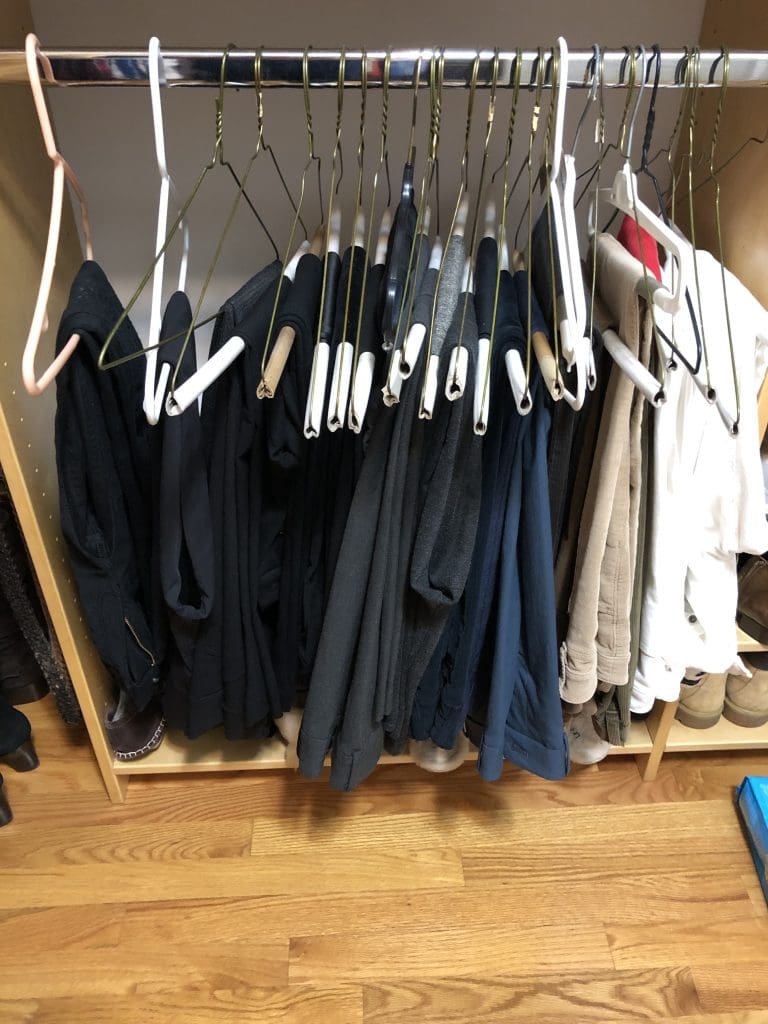
- Consider upgrading your hangers to create a uniform look and function. If your space is tight, space-saving hangers like these can make a big difference.

For items that you have decided not to reload into your closet, move them to wherever they should go.
- Clothes in good condition are sought after by charities, and you can often simply schedule a pickup at your home. Place these items in bags or bins and either put them in your car to be dropped off or in a staging area until they can be picked up.
- If you have investment pieces to sell, contact a reseller or drop them off at a consignment store.
- If you have unearthed items that really don’t need to live in your closet (which should be prioritized for clothes you are wearing), move them to a more appropriate space in your home. For example, if you find a screwdriver that was brought to your closet to fix a shelf, take it back to your tool storage area. Or, if you have old maternity clothes you are saving for the next time you are pregnant, move these to a bin or overflow closet.
* * *
Maintaining a closet is an on-going task. To help keep your closet from becoming “re-cluttered,” keep a bin somewhere to place any item you pull out and decide you no longer want. When the bin is full, drop it off at your favorite charity.
What solutions work well in your closet?


The biggest game-changer ever is the slim line hanger. Not only can you fit more in your space, it all hangs at the same height. Now your closet looks much more organized and you have the glee of having more in there!
Those hangers do provide a very satisfying result. Not only looking great, and having everything at the same level, but as you point out, saving space! Whether to get the ones that are flocked or not is a personal choice. Both have their plusses and minuses.
I love your step-by-step approach to closet organizing. Like you, I also love organizing closets, especially clothing.
Setting up a temporary clothing rack for sorting hanging items can be helpful. Sometimes, it’s easier to view and decide about pieces when they are out of the closet but easily accessible. I often use a bed to sort, but the rack is helpful when you have many pieces on hangers.
A clothing rack is a super option if you have one, especially one on wheels. Luxury!
Cleaning the closet takes too much time. The bin is a nice idea, or a big box. Thank you! -M
For me, no time is too much if it yields a satisfying result that makes my life better.
One of the benefits of a small closet is that I have to stay on top of it so I don’t run out of space!
That is so true! Small closets can only handle so much, so you have to be more diligent in an ongoing manner.
Thanks, Seana,
This is comprehensive, with many helpful tips. I agree with working on a section at a time if you only have an hour or two per organizing session.
It’s possible to work through any large space by going on section at a time. I know someone who does one kitchen drawer a week all year long. It works!
I also love organizing closets for all the reasons you listed in your post. I always encourage clients to also group by color. This not only helps put outfits together, it also makes them think twice before buying another clothing item in that color.
I also group by color, if we can. I’m not a huge “rainbow” organizer, but I think it makes sense with clothing!
Seana, you’ve now written the first complete chapter of your book! This is an exemplary book at everything necessary for organizing a closet. I particularly like the idea of separating out the memorabilia clothing; for those who won’t box/move that stuff, hanging it flush with the wall, all the way to one or the other side of the closet helps keep the closet functional.
Even though all the housekeeping rules say to clean downward, doing the floor last, I’ve found that taking everything out of the floor of the closet (shoes, boxes, random things) — even if you’re only going to be working section-by-section — and maybe even vacuuming (if it’s been a while) is a great way to energize the process.
I can’t stand those flocked hangers, but I did make an effort about a decade ago to slowly move toward uniform hangers. I started with (the narrower) white plastic tubular hangers, but when I found mauve ones, I kept buying those, using the white only for one category of clothes. Sadly, after many years, I couldn’t find the mauve ones anymore. Happily, I recently found purple ones in the same style, so now I’ve got sections — white for long-hanging, purple for tops, mauve for everything else, and everything hangs to the same height. The uniformity makes such a difference (and Joan Crawford was right: NO MORE WIRE HANGERS!)
Hangers are such a personal thing! The slimline come in both flocked and simple plastic. The simple plastic is awesome because it is easier to slide clothing on an off. My husband opted for these.
Sorry about the mauve ones. That always happens – when you find something you love, they discontinue it! 🙁
Clearing the floor is huge. It instantly makes the closet look larger, right?
I like your questions for deciding if you will keep a piece of clothing or donate or sell it. Another question that was suggested to me is “Do I get compliments when I wear this clothing?” This question may help if you like the piece but your not sure if you are going to keep it.
That’s a question I haven’t tried before. Good idea!
Closet cleaning is one of the most satisfying of all cleaning jobs. It is a constant job as you say. I like the one things at a time approach. I have shelves for my sweaters and I always do them on a separate day from the rods and other shelves. This is a reminder to clean my sweater shelves since i recently cleaned the rest of the closet. Great suggestions!
I love your approach, Dianne. That keeps the project from ever feeling too overwhelming!
I agree that you need to take everything out when organizing a closet. But it’s so satisfying to put only the good stuff back in a nice clean space!
Sooooo satisfying! A well-organized closet is one of the best “feels” in the house!
I have a bin on the floor of my closet, so I can toss things in it whenever I decide I’m done with it, and not just when I’m cleaning out my closet (or other area of my home). When it gets full, I know it’s time to take it to the donation centre.
I love this idea of having a dedicated donation bin. It’s so much easier to let pieces go in real time than having to try on a whole closet’s worth of clothes, right?
I just bought a rainbow colored hangers set and it really does make a difference to upgrade them! The ones I like are large and have those little hooks for dresses, tanks, or just sweaters not to slip off.
With back to school and a large party last weekend, we have done two enormous cleaning/decluttering sessions on the house and we’re in it right now. We did four large closets.
Wow, way to go! I’m cheering you on from down here. Nothing like a couple of parties to motivate you to get the house in order, right? How fun!