
Ever spend time organizing a space only to have it fall apart in a week? This is a common problem, especially in spaces used by multiple people. One helpful way to ensure that you and others stick with the system to use labels. Not sure where to begin? Here are some tips for mastering the magic of labeling basics.
Why Use Labels
Labels are like tiny, short instructions. They provide a concise visual reminder of what should—and should not—be placed in a particular space.
Labels help counteract the tendency to randomly put things where they don’t belong. It’s as if a tiny person is standing there saying, “Yes, this is exactly where that belongs,” or “No, don’t put that here. This space is reserved for something else.”
Labels are magical because they work 24/7, without electrical charge or WIFI. In addition, they work autonomously, without oversight or supervision. They just sit there, patiently ready to provide a visual reminder whenever necessary.
How do you make and attach labels? There are several options, each suited to a particular situation.
Ways to Create Labels
There are many ways to label things, ranging from the “cheap and simple” to the “fancy and elegant.”
Let’s consider a few options:
Permanent Marker
One very easy way to label something is to write directly on the storage container.
For example,yesterday I was splitting a large package of stew meat into smaller quantities to freeze and use in the future. I used a Sharpie marker to write on my freezer bags how much each contained, what the item was (helpful for things that become unrecognizable once frozen), and the date each bag was packaged.
If you want to write your own labels, but don’t want to write directly on a container itself, you can buy a box of blank labels like these. They come in a variety of shapes, sizes, and colors and are available at most office supply stores and online.
If you want labels that are a bit more decorative, you can download fancier ones from an online supplier.
Label Maker
Professional organizers love label makers. I remember loving the first label maker I ever saw: an old-fashioned embosser-style model. (You can see one here). I used to stand in the kitchen, turning the dial to make labels for various things. I guess I got started young in this business!
Label makers work well for non-porous surfaces and provide clear, easy-to-read, professional looking labels. They look nicer and more polished than handwritten labels, especially if your handwriting leaves something to be desired.
These days, label makers come in a variety of sizes and models. Before investing, there are a few basic factors to consider:
What size do you want?
I always have my handheld, portable label maker with me. It’s a very old Brother P-Touch, so old in fact that you can’t buy it anymore. This one is similar. I like it because I can keep it in my bag and pull it out to make quick and easy labels.
If you prefer a slightly larger keyboard, you may want a desktop model. Here is the larger equivalent of standard Brother P-touch labeler.
Label makers offer a choice of characters, fonts, symbols, and type sizes. It might take a bit of practice to figure out all the options, but generally speaking, they are very easy to use.
With standard label makers, you type in your label using the keypad and then press “Print.” The label is printed on a tape that comes out from an exit point on the label maker. You press the scissors button to cut the label off. Now you have a sticker to adhere to your surface.
Label ape is washable, can be removed, and has a light adhesive so that it can be re-positioned if necessary. Standard label tape has a backing that splits horizontally down the middle, so all you have to do is fold the tape back on itself to remove the backing.
What size labels do you want to be able to make?
Standard label tape is 12 mm (about ½ inch) tall, and the most common colors are white and clear. This is a great size for file folders, shelves, and small bins.
If you want to label larger spaces or containers, you might want a label maker that uses 24mm or 1” height tape. One popular model that accommodates this size is the Brother P-Touch Cube.
Some small label makers use tape that is fixed in width in addition to height. These are good for when you only need to print one specific size label, such as labels for files. For instance, this is a small one a client of mine is loving.
Whichever model you choose, be aware that once the initial tape cassette (the one that comes preloaded in your device) runs out, you’ll need to purchase and install replacement tapes. These can be ordered online or found in office supply stores.
Do you want to operate your label maker from your phone?
As I said above, the original label makers were designed to have you type the label directly into the device.
Newer models of various sizes and styles allow you to type labels on your digital device and connect to the label maker via Bluetooth. This is handy because you can create labels on your phone, tablet, or computer and then send them directly to the label maker to print.
What is your power source?
Another question to consider is whether you want a label maker that runs on batteries, plugs into an outlet, or is rechargeable.
Many models offer multiple options, including USB charging.
Pre-Printed Labels
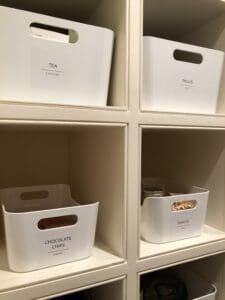
If you re working in a specific area, such as a kitchen, you may enjoy buying some pre-printed labels. The nice thing about these is that they come in a variety of sizes and fonts and require no effort on your part.
Here’s a set I used for a client in a kitchen. You can see the labels “in action” in this photo.
Pre-Made Labels
In some cases, you may want a label that is more than just a sticker. For example, maybe you want to label your luggage. Or perhaps you want to label clothing that will repeatedly go through the washing machine.
Personalized labels make nice gifts. They can also come in handy for labeling children’s items. Many vendors on Etsy and other websites offer customized labels.
How to Attach Labels
How you attach a label depends on the type of object you are labeling.
For flat, nonporous surfaces, adhesive labels work best. Labels which have built-in adhesive (e.g. those from a label maker) are simply “peel and stick.” Labels printed on regular paper can be attached by covering them with wide, clear packing tape.
For fabric, iron-on labels are easiest to use. If you want to attach a fabric label that doesn’t have a built-in iron-on adhesive, you can purchase iron-on tape.
For rough surfaces and oddly shaped objects, labels may need to be clipped or tied on. For example, if you want to label baskets, you might want clips like these or these. Some offer pockets into which you slip a printed label, while others provide a surface for you to write on. If you want a label that will hold on tighter than a clip, you might want to attach a plastic pocket with ribbon or a key ring.
To label something like a computer cord, use flexible labels designed to wrap around it. There are many varieties of adhesive cord labels. Some cable ties also offer a surface for writing a label, which is nice.
Ideal Places to Use Labels
The sky (or your family’s tolerance) is the limit for what you can label. It is possible to go overboard, so avoid using so many labels that your house starts to look like a retail store. Instead, begin by focusing your labeling efforts on spaces that frequently fall into disarray.
Here are a few uses where labels are particularly helpful.
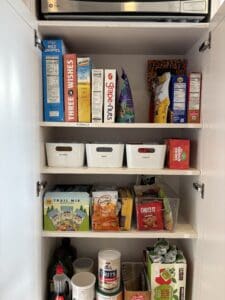
In the pantry
.
In the linen closet

.
Where you store tools and hardware

.
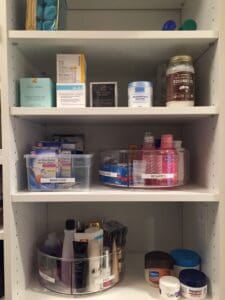
In a bathroom cabinet
.
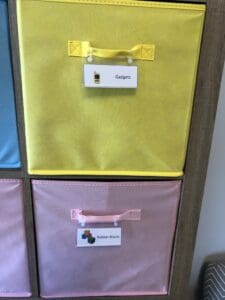
On toy bins
.
Holiday Decorations

.
Insider a drawer

.
On the front edge of drawers

.
On sporting equipment

.
In the mudroom

.
On electronics cords

.
On hanging files

* * *
Labels provide a clear way to communicate what goes where. If you have a “problem area” where things never seem to get put away properly, why not try adding some labels?
What areas have you found helpful to label?


I totally do need to label more and used to have a better system for this, but two kids later and not so much here sadly. You have inspired me and may need to get my labeling on. Thanks Seana 🙂
It’s never too late… just a fun little idea that can sometimes make a big difference:)
That iPhone charger label made me smile — I wrote my name on mine with a Sharpie because my husband was forever losing his charger and “borrowing” mine… then claiming it was his. No more! Labels to the rescue.
Oh I love that phrase, Sarah – labels to the rescue for sure!!
I need to label more! And I have a label maker too! This is a good reminder.
You have a label maker?? It’s all downhill from here then:)
I always love labels!! 🙂 I’m still using my mini-chalkboard labels because I can easily erase the writings on them and they look neat too.
I loved the mini-chalkboard labels!! They are so versatile because they can be easily adjusted:) Aren’t labels fun?
I totally need to label more- it’s definitely worth the effort when I do! Great post!
Nothing like a label to stop someone dead in their tracks from putting something down in the wrong place:) It really makes a world of difference….
I’ve been telling myself for years to get a label maker. I don’t know what my problem is! But labels would definitely make it easier to enforce my “a place for everything” rule for the kids. A tip for pre-readers: instead of a text label, use a picture label.
Definitely “yes” on the pictures for pre-readers! I think many children (perhaps not all, but many) do enjoy matching, so matching a toy to a picture feels fun.
I find that I need to label more and more these days…not for hubby and son, but for me too. I just wish I had more time to label. Great ideas though!
I agree, Karen. Labeling is as much for ourselves as for others, and it really does help when setting up a new system. Remember, they don’t need to be fancy.. a piece of tape will do!
These are all great ideas! The label maker reminds me of a Seinfeld episode!
Okay, not I’m laughing about the Seinfeld episode!!! I suppose you can get too much of a good thing:)
I love the idea of labels. That can cut out my husband’s excuse of “I don’t know where that goes”. I can even do pictures on the toy bins for my daughter.
Pictures are so great for kids! It’s just one of those little things that can make a big difference. Thanks for the comment:)
{Kathy} Oh please come to my house with that label maker! When I moved into my home, 7 years ago, I was very good about labeling everything in the cabinets and closets. Most of those are still there. I have discovered Label Tape that is very convenient to have around. My biggest hangup? I had to give up on the label looking too “perfect” and stick with handwritten ones. Thanks for the inspiration!
Nothing wrong with a hand-written label, Kathy!!! It isn’t about looking perfect, it’s about keeping a space in order. The fact that your labels are still there 7 years ago show that Labels Work!!!
I love the idea of potentially attaching labels to cords. Sometimes I feel we have so many chargers and cords that I can’t figure out which phone charger, lamp, or laptop each one belongs to anymore:)
That is a VERY common situation. I say all the time, label any new cord when it comes into your life because pretty soon you’ll forget what its for:)
Great tips! Now how do I go about getting husband and family to place items correctly with their assigned labels? …can only lead a horse to water…. 🙂
Well, you certainly have a point, JD. It isn’t magic! However, I think seeing the label on a spot does discourage casual stashing of stuff… if not, at least we can label and respect the spaces we have control over. It isn’t easy for sure.