
If you’ve ever looked around your home and thought, “How did I end up with all this stuff?” you’re not alone. Decluttering isn’t a one-time event; it’s an ongoing habit. The real question isn’t just how to declutter, but how often is it best to declutter in order to maintain a calm, organized space without feeling overwhelmed.
The Act of Decluttering
Decluttering is a relatively new verb in the English vernacular, added to the Oxford English and Merriam-Webster dictionaries in the 1950s. To declutter simply means to remove items that you no longer use, need, or love. Decluttering leads to actions like selling, donating, trashing, shredding, deleting, and recycling. When I work with clients, I always begin with decluttering, as this provides a clear understanding of what needs to be organized. As the saying goes, “Don’t waste time organizing what you could be shedding.”
Once possessions have been reviewed and edited, I then establish efficient storage solutions that the client can maintain. Putting things away consistently is critical for staying organized. People who maintain order tend to reset their space at least once a day. But how often should we actually declutter?
This is a nuanced question, and not everyone will have the same answer.
Decluttering Approaches
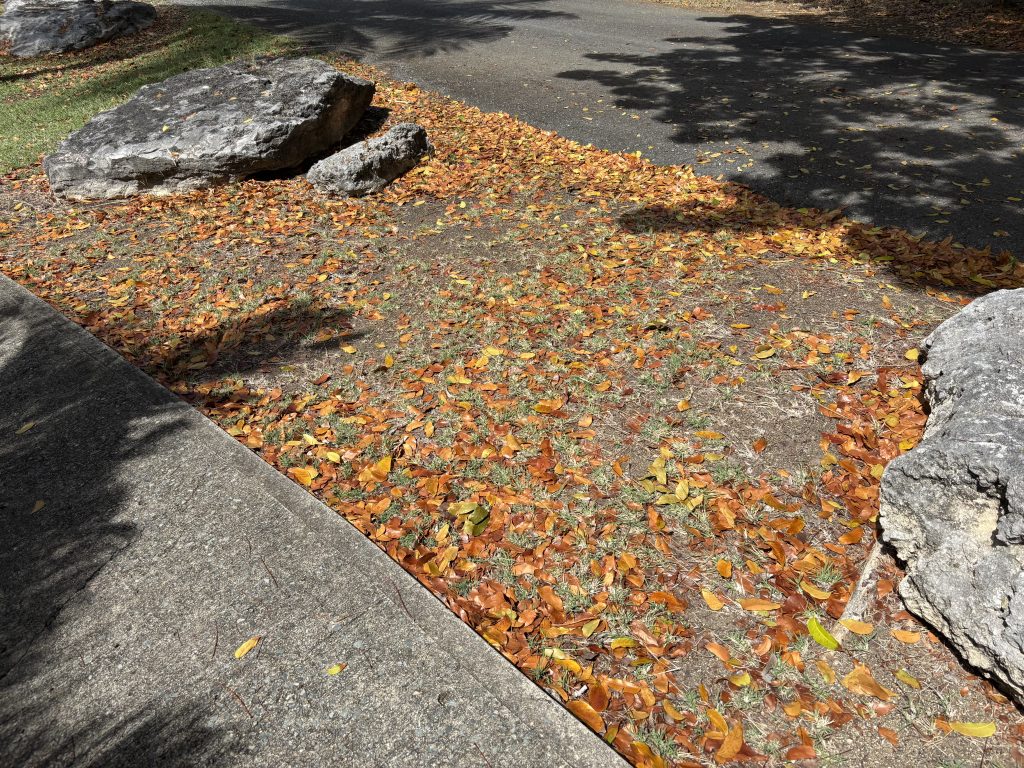
Recently I was on vacation in a tropical climate. I live in the Northeastern United States, so the climate in the Caribbean is very different from home. As I was walking around, I noticed that the tropical trees are constantly dropping a few leaves (or palm fronds). In contrast, the leaves in my area grow in the spring, mostly hang on throughout the summer, and then fall off in the autumn. Admittedly, there are some evergreen trees as well, but their shedding is less noticeable in contrast to the show of the deciduous ones.
Here are a few photos of the “gently shedding” trees I recently observed.



This contrast got me thinking about how differently people approach decluttering.
Some people take an “evergreen” approach. They are constantly reviewing what they own, regularly deleting photos and emails, and using a “one in, one out” strategy with their belongings.
At the other end are people who prefer to accumulate and accumulate and then do a major purge.
And of course, there is a small minority of folks who fail to ever clear out belongings. This situation typically ends poorly, with someone being forced to bear the burden of a huge project under a tight deadline.
Where you fall on this continuum can depend on many factors, including:
1. Your tolerance for visual clutter.
People who prefer clear surfaces and breathing room in cabinets will declutter frequently.
2. The size of your space.
People who live in tiny spaces are often forced to make perpetual decluttering decisions because they lack the physical space to keep things. Likewise, people with large homes often feel no need to declutter as they have “plenty of space.”
3. Your physical health and mobility.
Those who struggle to walk, lift, carry, etc. are more likely to allow items to accumulate because the process of decluttering and then disposing of items is difficult or impossible.
4. Your stage of life.
People with limited free time (e.g., working long hours, caring for small children or ailing family members, heavily engaged in activities, etc.) may find decluttering is low on their priority list.
5. Your project style.
Some people are more motivated by big, visible results. Small improvements don’t feel worth the effort.
Others feel intimidated by big projects and prefer to take small bites over time.
6. Your comfort level with making decisions.
Decluttering requires making decisions. Some people struggle to decide what to keep and what to let go of. Because these decisions feel uncomfortable, they are more likely to avoid decluttering.
7. Your level of sentimental attachment to physical belongings.
Some people are simply more sentimental than others. They can tell the story of each item and feel quite attached to possessions.
People who have recently lost a loved one may feel guilty about letting go of that person’s things.
8. Your skill level.
Some types of decluttering may feel especially difficult. For instance, figuring out how to delete or manage digital files can be hard for someone who is not well-versed in technology.
9. They accessibility of your belongings.
Many people have items stored up in attics, buried in basements, and/or housed in offsite storage facilities. The harder it is to reach them, the less likely you are to review it.
10. Other people in your life.
Some people want to declutter but are hindered by a spouse or partner who objects to your getting rid of things.
Alternatively, you may live with someone who constantly pressures you to get rid of stuff.
11. Life event or changes in circumstance.
Sometimes where you fall on the decluttering continuum shifts because of a change in your circumstances. For instance, you may be relocating/downsizing and need to suddenly get rid of a lot of stuff. Or you’re getting married and find yourselves with duplicate possessions. Maybe a family member will be moving in with you, and you need to clear out the “dump room” to make space.
These are just some examples. Your inclination to sort and edit your things may depend on any number of factors.
Should I Declutter More Often?
The question of how often to declutter ultimately comes down to how you are feeling about your space and belongings.
- Are you happy with the way things are? Do your possessions bring you joy and enhance your quality of life? If so, your current decluttering rhythm suits you.
- Do you feel overwhelmed or stressed in your space? Are you constantly misplacing items? Are your storage spaces overflowing? Does putting things away feel harder than it should? If so, you would likely benefit from decluttering more frequently.
Increasing Your Decluttering Frequency
Increasing the frequency of your decluttering might feel hard, but it isn’t impossible. Where there is a will, there is a way. There are many ways to make decluttering easier to start and maintain.
Here are some techniques you can try to ramp up your decluttering efforts.
- Set up a donation location so that you can easily collect donations as you come across them throughout your normal activity. Pull out a shirt and realize you no longer want it? Drop it into the donation container. Find a toy the kids no longer play with? Drop it into the donation container. When the container is full, put it in your car and drop it off at your favorite charity.
- Add trash cans to every room to make it just as easy to throw things away as it would be to pile them up on a nearby surface.
- Choose a “mini decluttering task” that you can attach to another habit. For instance, delete emails as you drink your first cup of coffee. Or, read accumulated magazines as you wait in the school pickup line.
- Invite a friend to declutter with you, either in person or virtually.
- Solicit a caring friend or family member to hold you accountable. Ask them to check in with you about your progress on your decluttering project.
- For digital photos, search all the photos you took on the current date over the years. Delete any you don’t want. If you have the discipline to do this each day, in one year, you will have decluttered your entire photo stream.
- Hire a professional organizer who can guide you in making decisions and getting rid of unwanted belongings.
- Take a “before photo” of a space you want to declutter and hang it up. Stay focused on this space before working on another.
- Declutter one room in your house each month.
- Set up a location to hold daily paperwork and then review and declutter this container once a week.
- Follow a decluttering challenge like this that has a task for each day of a month or one each week for a year.
- Use something like a decluttering deck of cards any day you have ten minutes to declutter.
- Schedule a pickup from a charity at your home. Knowing someone is coming is on a specific day to pick up your donations will keep you motivated to collect items to give.
- Declutter one drawer or one shelf a day in a room or closet.
- Select an area to declutter and clear your schedule for a week or weekend to get it done. Hire extra muscles (e.g., a high schooler) to bring your items to a location where you can review them. If applicable, hire or trade babysitting so you can work without interruption on the task.
- Build the habit of restoring order daily if you are not already doing this. Putting things away is easier in a decluttered space, so you will be more motivated to let go of things that make this habit unnecessarily difficult.
- Invite family members to join you in a decluttering project. Even children can help.
- Promise (and then give!) yourself a reward when you finish decluttering an area.
* * *
Decluttering isn’t about perfection. It’s about alignment. You may find that you frequently edit some of your belongings, while others tend to build up.
Whether you shed a little each day like an evergreen or do a periodic reset, the goal is the same: to make space for what truly supports your life.
What spaces or categories are you most likely to avoid decluttering?


I love that you are giving people the thought that there is a routine and pattern to decluttering. Because life is so fast now, I am sure many people are not aware that they have this opportunity to make a change as frequently as they like. You offer many choices for what’s best for each individual. Thank you!
I declutter more frequently now than I ever could have when my kids were little and underfoot. Organizing works best when customized to fit each person’s situation. It isn’t “one size fits all.”
I agree, Seana. There are as many reasons for people to engage in a decluttering process as there are for people to avoid it. I love the way you structured this post and addressed many of the reasons. My favorite line in this piece is: Decluttering isn’t about perfection. It’s about alignment. This resonates with me because once you review your space, your values, your tolerance for clutter, and understand what matters most to you decluttering happens as part of the rhythm of your life.
I hope you get some hits to your deck of cards from this post too, Diane!!
Thank you for highlighting our organizing deck of cards!
I do major decluttering one zone at a time, but I continually declutter small stuff.
I am most likely to avoid decluttering my digital stuff.
Me too. That feels the most tedious of all decluttering to me.
Great post, Seana. I hope you had a relaxing vacation.
I love to declutter daily, weekly, monthly, and quarterly/yearly. I have a smaller home, and over the years, I have gotten into the habit of decluttering in this way.
This past weekend, I started decluttering areas like outdoor cabinets, the bathroom linen closet, the vanity drawer, the kitchen junk drawer, etc. It’s not the time for spring cleaning because it is too cold here. So, to feel productive, I would go through the small things throughout my home. I got rid of about 3 bags of things that were just junk, broken, and not needed or reusable.
I felt so much better after I did this, even though it was a little decluttering. Any release of stuff is a step forward to feeling lighter.
I think decluttering almost always leaves us with a “lift” in our spirits. It is a physical lightening up, and we actually sense this change.
I hear you on the “too cold.” Enough already!!
These are great, practical tips! I love that you acknowledge that we all have different relationships with and attitudes towards clutter too.
Decluttering and organizing are not one size fits all!
So many excellent points, and your advice is spot-on!
While I hate to be sexist, I’ve found that there’s a general tendency toward gender differences regarding frequency of decluttering. When they are *able* to, I find that women prefer maintenance, small but regular habits for maintaining a space, akin to the concept of “clean as you go” while cooking. Less labor, or at least smaller efforts, but with more frequency can often be the norm (for those who ARE able to effect change on their own).
Conversely, I find that male clients prefer a big “payoff” related to the tasks that they are culturally assigned, doing tasks less frequently but with more effort all at once. They seem to prefer the louder, more effort-ful “Ta-Da!” of doing something once a month or quarter or year — they want to wait until something is visibly dirty to clean it, and they want to wait until the clutter is visibly messy/problematic before decluttering it.
In this way, I suspect that frequency of decluttering is, at least in many ways, a direct results of socialization, whereby cleaning/tidying/decluttering the bathroom or kitchen (usually done by women) is a daily set of tasks, whereby yard work, washing a filthy car, or clearing the garage is more of a weekly/quarterly/annual task usually assigned to men.
Similarly, I believe tolerance for visual clutter tends to be socialized into someone’s trained perceptions, as well. Because of this, it’s important for couples/families to get on the same page regarding expectations of what and how often decluttering will be done.
As always, socialization can be modified, but it takes effort.
Very interesting, Julie! I’m going to pay attention now to gender when I have these conversations. The impact of socialization on our daily behaviors is a big topic with far-reaching implications. I do think unwinding social norms takes some work and commitment for sure. Thanks for the comment!