

Have you ever described yourself as messy? If so, why did you do that? Do you leave things lying about? Do you only wash a dish when you need a clean one? Do you cringe to remember the last time you ran the vacuum cleaner? Have you ever described yourself as disorganized? What were your reasons? Were they because things looked messy? Maybe because you couldn’t find things, or were surrounded by piles of stuff? Words can be confusing. Are you messy or disorganized? What is the difference? More importantly, why does it matter?
In general, I find that putting labels on people is rarely useful. First, because the labels are often inaccurate, carelessly tossed out in moments of emotion. Second, because labels can become self-fulfilling. When we put a negative label on ourselves (or someone else does), we tend to lean into that label, as if the word in some way determines our thoughts, actions, behaviors, and potential.
So, let’s begin by setting aside whatever you have been called, or whatever you have called yourself, in the past. You can think and behave in whatever you way you choose from this moment forward.
Instead, let’s consider how these terms might describe habits we have developed over time.
The word “messy” is, at best, a vague term used to describe the state of a person or space in a moment in time. Messy is primarily describing how things look. For example:
- Hair when we first wake up
- An unmade bed
- A heap of clothing on the floor
- A car full of trash
- The kitchen after a party
Messy can also mean complex, having many aspects, and/or being chaotic or tangled up, as in:
- A messy divorce
- A messy corporate scandal
- A messy custody battle
There are many reasons why a person, space, or situation may be messy, and most of them are not because someone is disorganized. For example, after a tween sleepover or a cookie decorating party, a space may be quite messy. But that doesn’t mean that the event was disorganized, or that the person hosting the event is disorganized. It is simply the natural outcome of that type of gathering. We wake up with messy hair because hair gets mussed while we sleep. Processing the estate of a departed loved one is messy because a life is multi-faceted, and disentangling it takes time.
“Messy” is not a particularly helpful word when talking about getting organized because it offers little insight into why things are out of order.
Let’s turn our attention to the word “disorganized.” This word tends to describe the way a person or situation functions, and the corresponding results of this functional pattern. We might say a person is disorganized if he/she:
- Frequently misplaces items
- Is chronically late
- Fails to put things away
- Keeps more than the space can accommodate
- Forgets appointments
- Misses deadlines
- Can’t find belongings in a timely fashion
Like the word “messy,” the word “disorganized” is often used to describe the current state of affairs. It just tends to focus more on the way a person, organization, or system is operating, as opposed to how it looks.
Since there are a plethora of reasons why a person may be disorganized, even this term is not particularly helpful when trying to get organized. For instance, a person may be disorganized because he/she:
- Has never learned how to be organized
- Is overwhelmed by responsibilities
- Lacks sufficient tools to be organized
- Is living with a physical limitation
- Is living with ADHD, a traumatic brain injury, Autism Spectrum Disorder, or other chronic challenge
- Lives in a setting where others undermine his/her efforts
In order to get organized, the first step is to identify what is the true cause of the situation. This may take a bit of investigating, as we are not always aware of why we are struggling. It may also take a bit of trial and error in order to figure out which solutions end up being the most effective.
It is important to acknowledge that people can differ in their goals, and in the way they describe being organized. I would argue that “organized” does not mean:
- A minimalist space with very few possessions
- The presence of pretty containers
- Having everything tucked out of site.
- Getting rid of everything you haven’t touched in a year.
- Never having stress or problems.
Organized people may have a reasonable number of belongings, held in appropriate containers, that they use to help navigate life’s challenges in an intentional manner. Admittedly, organized people generally move through life more easily than their disorganized counterparts, but not because they don’t have problems. Rather, their structures, systems, and habits equip them to respond as well as possible to current situations without being bogged down by decisions and items from the past.
In regard to having things tucked out of site, I have observed that people differ in what they prefer. Look at the chart below.
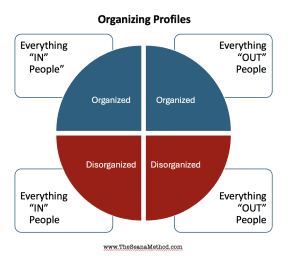
In general, I observe people are often either “Everything IN” people or “Everything OUT” people. Some people like having items out in plain sight where they can see them. Others do not like visual clutter and prefer items to be contained inside drawers and behind doors. The funny thing is that neither profile determines whether a person is organized. For example:
- Someone who despises visual clutter may stuff and stash items haphazardly into drawers, which is very disorganized.
- Someone who likes seeing belongings may have a wall of clipboards with detailed project plans on each one, which is very organized.
So where does all of this leave us?
First, if you have fallen into a pattern of negative self-talk, or have labeled yourself as “messy,” “disorganized,” or something else, I suggest you mindfully cease this habit. We are what we consistently do, and behavior is something we have the power to change.
Second, consider whether you honestly want to make a change. Are you happy with the state of your time, space, and belongings? Is it all working for you? If the answer is yes, regardless of what others might say about how you do things or how your space looks, you are probably in good shape.
In contrast, if you are frustrated with your space and productivity, you may want to consider what modifications you can make to set yourself on a better path. A few questions you can ask to figure out what needs to be done include:
- If I were to try to put all my things away (wherever that is), could I do it? Have I designated “homes” for everything I own?
- Am I taking full advantage of the storage and functional spaces I have? Do I know how to do this? If not, am I willing to ask for help?
- Am I keeping more than my space can reasonably accommodate? Do I need help with letting go?
- Do have a consistent approach to managing my time and tasks? Do I frequently feel like I’m “behind the eight ball” and not accomplishing important tasks?
- Do I feel like I struggle more than others with being organized? Where am I having the hardest time?
- Are there other people in my life who are making being organized hard for me? If so, how might I change that?
- Am I willing to invest time and/or money in order to make things better?
- Am I willing to accept help from others, be that in the form of instruction or accountability?
* * *
Have you ever considered yourself to be messy? How about disorganized? Do you identify as an “everything IN” or “everything OUT” person? What do you feel you are lacking to help you move forward with a fresh mindset?

Of all the stereotypes and labels, I find that these are not constructive for change. I love the reframing here to help people understand their strengths and how to use these more successfully.
Right? Labels just put people into mindsets that can be destructive barriers to progress. Everyone has strengths, so stay positive!
I also do not like labels. For me, labels are great for things or where to place things and not for people. I like the way you pointed out that just because things may look organized at first glance, they may not be. And, just because there are lots of things out in the open, this is not an indication that the space is disorganized.
Something else to think about is if the organizational strategies (or lack thereof) have an impact on the way the person wants to function. Is there a financial impact? Is there an impact on their relationships? And, is there an impact on the way they want to spend their time?
This is a great post, Seana, with lots of great things to think about.
Love this point, Diane, about organizational strategies. The psychology behind why we do what we do is deep, much deeper than I anticipated when I got into this field 14 years ago. This is why listening and understanding are so important!!
I love your deep dive into not labeling people, the differences between the meanings of messy and disorganized, and the wonderful set of questions you provide to help identify where a person might want help.
As far as “all in” or “all out,” I suspect some crossover. For example, I love having many things put away in closets and containers and out of sight. However, I also enjoy having certain things out and visible. I’m more of a “some in/some out” on the organized side of the diagram.
I love that you are in the middle of the “in” and “out” groups. As with all paradigms, they are not completely black and white. I would identify as an everything “in” person, but as you point out, I still do keep a few things out for easy access.
Let’s leave the labels on the stuff, not the people, right?
You’re so right that labels (on people, in particular, but also on behaviors) is counterproductive. I’m a professional organizer, so I’m (pretty obviously) highly organized, focusing on structures, systems, habits, and the way things function. But I can also be pretty messy in certain spaces or at certain times — my cosmetics tray or even my whole bathroom counter when I’m getting ready in the morning, the area around where I sit when I watch TV (and open mail, and read magazines, and snack). Eventually, it all gets tidied, and I know what goes where, and everything does, indeed, have a home where it lives. Messy, for me, is situational and brief, while being organized is a constant.
There are a LOT of people who fall into the “everything IN” or “everything OUT” categories, though I’m definitely not one of them. I’ve had clients who even wanted their books hidden! I prefer more things to be “in” than most; I don’t like open shelving in kitchens or even cabinets with glass doors. But I don’t need everything physically contained and hidden just for the sake of having a unified look and cute storage.
I’m really glad you brought up this topic; it’s something I’ve thought and talked about before, but not with the sense of clarity and focus you’ve shared.
I’m not a fan of the open kitchen shelving either.
I had a client once with a clear refrigerator door. Talk about pressure!
I think you bring up an important point. Having the ability to put things away (if you want to) is key. If you feel that cannot put things away, then you might need some help.
Good definitions of “messy” and “disorganized”. I think people tend to use “messy” more because they understand it better. I have observed a few clients change their vocabulary once they get organized. Then they don’t feel so “messy”.
I love when clients can change the way they feel about themselves. Mindset is very critical, and we don’t help ourselves by living in shame or telling ourselves we can’t do something.
Great post, Seana. So many people use the word “messy” to describe themselves. They make it part of their personality when it is not.
I think of messy as a negative term. If one says they are messy, they may be blocking themselves from finding solutions. Instead, saying, “I feel disorganized in ______ space,” will allow them to be open to finding solutions for the cluttered space and not making it a part of themselves.
Yes, messy has a negative connotation. When a person assigns a word like that to themselves, it’s just as you said, they consider it part of who they are, rather than a pattern of behavior. Patterns can be changed, but personality tends to be fixes. So good to bring up this point!
I love the distinction you’ve made between messy and disorganized. I’ve definitely worked with people whose office was in a constant state of disarray, but they knew exactly where everything was. I guess that would make their office messy and not disorganized. One could argue, however, that if they were off work unexpectedly and nobody could cover their workload because they couldn’t find the files, it’s not all that organized either.
That’s an interesting angle, Janet! Does our space have to be set in such a way that someone ELSE could in and find what was needed? That might be another post!
I agree, I don’t like label. I find too many people hide behind them and it makes the situation worse! Great Information here! Thank you.
Glad we are on the same page, Florena! Labels are for shelves and containers, not people!
I am an all out person who tries to do that in an organized way. I learned that everything out is not good for many reasons, but I need the visual reminder to motivate me to clear it off. I think I am pretty organized but could still improve things, I also agree about negative labels. They serve no useful purpose and discourage the person. It can extend to negative thinking in other areas and become a habit. Good post.
Excellent point about how a negative label on one part of our lives can extend to other parts. Either way, just not useful! Everything out isn’t all bad, so as long as you are organized, enjoy who you are!
Great insights! I’ve always labeled my space as ‘messy,’ but this post helps me see the difference between being messy and disorganized. It’s a helpful reminder to focus on the root causes rather than just the labels. Thanks for sharing!
Labels are better for bins and shelves, right?