
Most people keep things for sentimental reasons. Memorabilia is an important part of our lives, and everyone in the family should feel justified in keeping meaningful pieces. The key is figuring out what to let go of, what to keep, and how to preserve the pieces that matter most. What is the best wisdom for how to keep memorabilia?
Deciding What to Keep
Because memorabilia is rooted in emotion rather than logic, deciding what to keep can be difficult. Sorting through it alone can feel overwhelming. Nevertheless, we need to regularly review our keepsake collection to keep it from getting out of control. As I often say, “Too much of anything is hard to enjoy.“

When you are trying to figure out what is worth holding onto, consider these two rules of thumb:
- Keep items that bring you joy when you look at them. For example, objects that remind you of a favorite time in your life, an accomplishment that you are proud of, or a person whom you love. After all, keepsakes should provide an emotional lift associated with a memory.
- Let go of items that elicit a negative emotion, such as guilt, regret, sadness, or pain. Possessions which stir undesirable feelings are doing the exact opposite of what memorabilia is all about. Bear in mind that there is no “should” with sentimental possessions. For instance:
- If the wedding album from a previous marriage makes you cringe, you are free to let it go.
- If you hate the way you look in your graduation photo, throw it out.
- If you spent a lot of time and money amassing a collection, but no longer want the collection in your home, donate it.
- If you don’t like something you were given as a gift, you are free to get rid of it. A family connection alone isn’t a good enough reason to keep an item. You won’t forget the person simply because you got rid of something he/she gave you.
- Your home is meant to be lived in, not used as a storage unit. If you are burdened by family heirlooms, reach out to family members to see if they can share the burden. If they cannot, let them know what you will be keeping and that you will be donating the rest.
Storing What Matters Most
Once you’ve decided what you want to keep you are ready to assign it to appropriate containers and storage locations. One simple solution is to get a large container (or two) into which you place your special things. I suggest every family member be given such a container and labeled with their name. Popular choices include a plastic bin, a designated drawer, or a decorative box.
A keepsake container works well for a variety of objects and, if your collection is modest, may be all you need. However, some people have more extensive memorabilia that they wish to store distinctly, rather than mixed in with other items. Here are some thoughts on how to store specific types of memorabilia.
Photos
Photos deserve special consideration because they require different storage and preservation methods. (You can read more here). Generally, you want to store photos in a space that is:
- Climate controlled.
- Designed to keep the photos from getting damaged, such as in an acid free photo album or photo box.
- Organized and searchable (e.g., with keywords, tags, or chronological grouping).
- For digital photos, backed up. The general suggestion is to have double digital backup (e.g., one on an external drive, on something like “Picture Keeper”, and a second copy in a cloud-based storage location). For your favorite photos, make a printed hard copy as well. This might be some favorites that you hang on the wall, or photo books you print once a year or after a vacation.
Clothing
Like any belonging, clothes can carry emotional value. We often keep sentimental clothing for a purpose other than covering our bodies. If you have some favorite clothing items (e.g. a varsity letter jacket, the dress you wore when you got engaged, etc.), keep them, but not in your closet. Move them to a designated memorabilia box (a bin, labeled by name) or a wardrobe box/bag. Since you aren’t wearing these pieces, they can be stored more remotely, such as in a spare bedroom, in a cedar closet, or in the attic. Be aware that clothing is vulnerable to temperature swings and insects. If you want more tips for storing clothing, click here.

Artwork
Most parents are emotionally attached to a child’s artwork. Especially when they are young, kids tend to bring “masterpieces” into the home almost every day. The secret to managing artwork is to break the management of it down into steps.
- Hang it up when it first comes in.
- Move it to a temporary storage location as it comes down to be replaced by newer pieces.
- Review the work annually and keep only the best pieces.
- Potentially digitize the collection.
You can see more detail on this approach in this post.
Beyond the artwork made my children, you may have other types of artwork that carry sentimental value. For instance, a painting of the first home you lived in, or a piece made by a family member. The key to storing artwork like this is ensuring that it is kept in a place where it will be safe from the elements. Does it need to be framed and covered with glass? Is it in a place where the afternoon soon won’t damage it? Are you storing your pieces in a location that is safe from flooding? If you have more than you have space to display, consider investing in containers designed specifically for holding art, such as an artwork storage bag, portfolio, or artwork rack.
Trophies, Medals, and Awards
Trophies and awards are unique in the way they represent accomplishments. They often remind us of some of the best moments in our lives, bolstering our confidence and giving us motivation for future endeavors. However, not all trophies, medals, and awards carry the same emotional benefit. For example, prizes and trophies that were given for simply “showing up” generally don’t have enduring value. Furthermore, the passage of time can also change the way we feel about an award. For instance, a prize received in preschool may not matter much to a teenager.
As with artwork, it works well to set aside space where celebrations of current achievements can be displayed and enjoyed. Shelves are good for trophies, while hooks work well for medals. Paper awards can be placed in frames and hung on the wall.
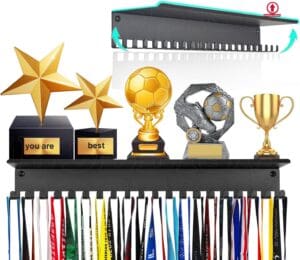
As new awards are earned, older ones can be removed and either stored in a bin or discarded when they lose their emotional “punch.”
Souvenirs
Souvenirs are fun to buy but can easily become clutter. What seems wonderful in the moment may seem less appealing as the years pass. Before you head out on a trip take the time to intentionally assess whether all the souvenirs you currently have on display are still “justifying their real estate.” Do you still love them? Have you got tired of seeing them and are ready for something new?
If you want to keep all of your souvenirs, but lack space to display them, consider rotating them as décor in your home. Not every piece needs to be out at all times. For future trips, consider purchasing artwork for the wall, holiday decorations, or clothing instead of knick-knacks. (You can read more about the best strategy for souvenirs here.)
Paperwork (Tickets, Playbills, Sports Programs, Maps)
Many life events come with paperwork. Whether you keep it or not is up to you. If you decide you wish to keep it, designate a location where you will collect it. For instance, you have make a hanging filed called “Memorabilia,” either by year or by person. It doesn’t matter if you add to the front or the back of the file, just be consistent with your approach.
It’s a good idea to review this file annually. As with other keepsake pieces, you may find that older pieces of paper mean less as the years go by.
Going forward, you can either leave them in your storage spot, or move them to a decorative box. If you have a lot of paper, you may want a box for each year (remember to label it). Items can also be digitized and added to a photo book or photo collection.
Collections
Collections often begin as souvenirs or gifts, and then take on a life of their own. Read here for more details on collections. Collections are meant to be displayed and enjoyed. If you want to collect, you need to decide where the collection will live. Some you might be able to hang on a wall. Others might need to sit on a shelf. Some items are popular to collect (e.g., trading cards, postcards, etc.) and you can find containers designed specifically to hold them. Remember to consider how you will protect the pieces from wear and tear, and if you have valuable items, to insure them.

As with the souvenirs, you may choose to display only a portion of your collection at one time. Also, if at any time you find yourself with too much of a good thing, you are free to cull your collection and keep only your favorite pieces. When word gets out that you collect something, it is easy to find yourself with more than you ever wanted.
* * *
More than almost anything else you own, memorabilia benefits from regular review. The whole reason we keep it is so that we can look at, reminisce, reflect, laugh, share, and smile. If all you ever do is gather, containerize, and store your keepsakes, you are missing out on the inherent benefit of keeping them.
The best way to review memorabilia is by establishing times when you will review it. For example, you can set one date each year when everyone looks through their memorabilia boxes, such as around a loved one’s birthday, a holiday, or the last day of school. Reviewing keepsake containers can also be a fun rainy day project.
Alternatively, you can decide that you will review memorabilia whenever it feels like “too much,” such as when you can’t fit items into your box anymore, or the shelves holding your souvenirs are feeling crowded. You may wish to review a few photos each day. I’ve recently begun searching the current date in my photos app each morning. Not only am I finding many photos I no longer want (and can easily delete), but I’m enjoying reliving past experiences. It only takes about 2-3 minutes.
One final thought: don’t be too hard on yourself when it comes to shedding sentimental possessions as this is the one type of object you can’t easily replace. When in doubt, keep it. As long as you come to periodically reviewing it, you’ll have another chance to rethink your decision in the future.
Memorabilia isn’t valuable because you own it. It’s valuable because it helps you remember the people, places, and moments that shaped your life. Choose the pieces that continue to tell your story, protect them well, and revisit them often so they can keep bringing you joy.
Where do you keep your memorabilia?


Interesting! I had never heard of Picture Keeper but now I think I have to check it out. I have trouble letting go of clothes and my children’s items sometimes but I do think I’ve gotten better about it. My husband will easily trash anything and I won’t, but we generally meet in the middle.
Being married to someone who either more or less easily parts with items is the norm! The good news is, we balance each other out! For true photographers, more serious back-up than Picture Keeper is needed, but it is a first step for those who aren’t backing up yet. Have a great day:)
It is so hard to decide what to keep and what to throw away…everything feels valuable, but I am so sick of clutter! ;)-Ashley
It is hard, Ashley. Sometimes having someone with you can help give another opinion, whether it is a professional organizer, or just a friend. In the end, the clutter isn’t bringing you joy. Be strong and let some of it go! Thanks for reading:)
How wonderful advice, Seana! I really needed the tip on keeping kinds art projects and when to get rid of it, thanks!
So glad you found it helpful! I’m working with a client making books through Artkive right now and they are coming out very cute! Thanks for stopping by:)
these are all awesome tips…I need to pin this and follow your suggestions. I am so bad at keeping memorabilia..I usually throw things out rather tan deal with clutter…which is bad.
Your post on closet organization is being featured on my post today! LOVE the tips and used some of them.
Thanks so much for the feature, Karen! So glad some of these tips are proving helpful:) Deciding what to keep is definitely the tricky part… but I think you are doing a pretty great job!
I never heard of Artkive App before, but thank you for sharing that. Just downloaded it and definitely going to try this to keep track of my girls artwork now for this school year. And thank you also for stopping by my page today, too! 🙂
I love the tips on what to keep and the storage ideas. I need to apply these tips to some tubs of the kids’ stuff in our basement (I’m thinking I can part with a lot of preschool papers that were from my oldest son, now 12). I also wanted to let you know I nominated your blog for the Liebster Award–just a fun thing that says I really like your blog 🙂
Wow, Jean – I’m honored by your nomination! I just went through bins of old toys myself that have been in the attic. Thought I’d keep them for grandchildren, but then realized I had kept way too much. Liberating! Thanks so much for reading.
Great ideas! I often struggle what to do with pictures, especially the old school physical ones. I decided on going through them and store the “keepers” in a box, but now I need to carve out time to do that. In the interim, they’re all in a bigger box.
I love purging clutter, really I do. When I’m done it’s like I’ve lost 5 lbs. We just moved, and before we did, I purged a lot of stuff, but my husband didn’t. He likes to keep things. Seriously, we still have some of his college papers. (WTH!?!?) Then to see it all come marching into our new home freaked him out, especially since I told the movers to put all of his crap in his office so he had to sort through much of it and I’m so proud of him.
I still have crap I want to purge, but I find it’s a process, especially as I work part time, have two small kids, blah blah blah. But I’m getting there. And whenever I need a swift kick in the pants, I watch an episode of Hoarders or a similar show and that makes me itch to clear our crap.
BTW, visiting from SITS.
Congratulations to you on working away at the clutter! It is so common for one spouse to have a tougher time than the other – I smiled at your idea of putting all of your husband’s belongings into his office… that can be motivating. With a busy life like yours, small projects over time can be a great way to go. Thanks so much for stopping by!
Popped in from SITS! Organization is the hardest thing for me!
We all have our strengths and weaknesses:) I learn from others through SITS. Thanks for reading!
I like the idea of displaying trophies that you recently received. remembering your accomplishments can help you stay confident and shoot for the stars, but they can definitely pile up and then feel like clutter. Thus, rotating them out and just showing one or two at a time would be a great idea.
Pingback: Incorporating Framed Memorabilia as House Decorations
This is a great topic to revisit. Memorabilia is indeed so hard. Your ideas for storing collections are terrific but what I really love about this post is the permission you give the reader to remove things from the collections of memorabilia that don’t make you happy.
Right? When we can step back and take an objective look, it makes sense to let go of items whose only contribution to our lives is negative!
Thanks for sharing this. What to keep and how to keep it varies so much with different people.
I have worked with parents with younger children and recommend to them that they get an art portfolio for each child and at the end of the school year they sit down with their child and choose together what pieces of art or schoolwork should be saved. Use one slot per year.
I also am a firm believer that memorabilia should be reviewed once a year. I do a Zone Plan review of my home and in February I work in the spare bedroom where my memorabilia is stored. One or two evenings during that month I will bring it out into my living room and go through all of it. I usually let some items go each time I do this. If you don’t take time to look at your memorabilia, why are you saving it?
That’s exactly the point, Jonda. We keep the memorabilia so we can look at it and enjoy it. We shouldn’t just shove it into boxes we never see!
Love that you hit your memorabilia collection once a year as part of your Zone Plan.
Memorabilia is probably the hardest ‘household’ category to work with. It brings up so many emotions- the good, bad, and the ugly. It’s not always clear what to do with the things that bring up negative emotions because there can be guilt in letting those things go. But I love how you gave permission to do just that. I suppose there might be extenuating circumstances to keep a few things that bring up unpleasant memories (like if you plan to write about them), but for the most part, I agree with you that letting them go is okay.
I remember when I turned 60, I wanted to go back and read all of my journals from the first one (started at age 12) to the present day. I had forgotten about some painful times. It was interesting to read about those stages, but I finally had to stop. It brought up too much. I never made it all the way through. But it sure was fascinating to see the journey, the growth, the repeating patterns, and the learning. By the way, I still have all of my journals. I don’t plan to throw them out. Someone else will have to do that. I can’t believe I’m saying that.
So funny that you are sharing about your journals as In and Out Organizing wrote on this very topic this week, and I thought it was so helpful!
I once heard it suggested to keep them in a container with a note that says, “Feel free to toss when I’m gone.” That gives permission to the kids who may struggle with the decision.
Memorabilia are hard to go through. I know, personally and professionally, the struggle of deciding what to do with the items. It is best to go through these areas at a pivotal moment. I liked to go through my memorabilia in the summer between elementary school and middle school, between middle school and high school, and then again from high school to college. I always promised myself that if I didn’t remember why I kept something, I would get rid of it. But if I didn’t want to forget something, I would attach a note about why the item was important. That helped a great deal in keeping my memorabilia streamlined. Thanks for sharing your thoughts, Seana.
That’s a great tip, Sabrina! Attaching a note is a good idea if we think we may forget why we kept something and yet still truly wish to hold onto that memory.
I so agree that many are looking for permission. In estate and downsizing work I see how often people keep a thing out of guilt rather than love and agree that letting go of a wedding album from a marriage allows them to keep what actually tells their story. Your point about reviewing keepsakes on a set date is one I’ll be passing along. Boxing them up and never looking again is how memorabilia turns into storage.
Downsizing is often an experience that hits this topic squarely in the face. Few have the space in a smaller home to simply “archive” all the stuff they’ve been saving for years.
I think the annual review can be a joy, not just a burden. It exposes us the memories we wanted to savor, which is the entire reason we are keeping it, right?
I’m so glad you mentioned memorabilia that brings up negative emotions. I’ve had so many clients who have felt obligated to keep such things, and it takes a little discussion to get at the answer to, “Who told you that you have to keep this? What makes you feel like it needs to stay in your life? Would you want your best friend or your child to have to hold onto this kind of thing?”
Outside of photos, I rarely keep memorabilia long-term. I have a collection (“the boy box”) from a long-ago long-term romance, and perhaps some day, I’ll be ready to get rid of the contents, but otherwise, programs and brochures and memorabilia that can’t also be *used* (such as jewelry or clothing) just doesn’t come into my life. And yes, memorabilia clothing that you aren’t going to wear, like a cheerleader uniform, is best kept as memorabilia and not among the wearable clothes.
Your advice is spot-on for all of these categories! And this weekend might be a great time for me to do another review!
I was nudging myself for another review as I wrote this LOL!
At one point I saved Playbills. I have a drawer of them, and they aren’t all mine because my daughters put theirs in this same spot. I feel a purge coming…(and I no longer keep them!)
Memorabilia is possibly my biggest downfall when it comes to having too much. However, I’m getting wiser in my old age! I used to have a huge Rubbermaid tote that I called my treasure box, but I’m managed to whittle it down to a much smaller container.
I do think that happens when we review it regularly. Things that used to mean so much sort of fade in significance. A smaller container is easier to access and enjoy. Good for you!!