
One reason many people resist letting go of their possessions is because they feel guilty. For a variety of reasons, it is natural to feel bad about getting rid of things. Nevertheless, to live an organized life, it is important to regularly review and curate the things we own. When we fail to declutter, our spaces often become overwhelmed and difficult to manage. The good news is that it is possible to declutter without negative emotions. Here are 10 reasons you can declutter without guilt.
Why We Feel Guilty
Feeling guilty is not a sign of weakness. In fact, it is often a sign of emotional depth. Frequently, it is the most sensitive, thoughtful, and kind people who struggle the most with experiencing guilt when letting go. The intent behind the hesitation is typically positive, such as:
- Not wanting to hurt someone’s feelings.
- Wanting to justify acquisition cost.
- Desire to keep things out of landfills.
- Plans to repair rather than throw away.
- Wanting to honor a loved one.
The relationships we have with our belongings are complex. Therefore, it shouldn’t surprise us if we experience some angst when deciding what to do with them. However, avoiding the decluttering process creates its own kind of guilt, the guilt of procrastination and shame. A better approach is to consider decluttering a type of home maintenance that optimizes efficiency and cultivates a healthy, pleasant living environment.
10 Reasons You Can Declutter Without Guilt
If you struggle with guilt whenever you try to declutter, here is your chance to reframe your thinking and start fresh. Consider these reasons why you can let go of guilt and move forward with confidence.
1. The value of objects fluctuates over time.
At any given moment, any given object can be a “hot commodity.” When I was growing up, baseball cards were all the rage. Other items that, at one time or another, were considered valuable range from Beanie Babies to Hummels to stamps. We often invest in an object because we believe it will increase in value over time.
Unfortunately, this often does not happen. Many of the “collector’s items” of the past are not popular today. Markets are fickle. Yesterday’s specialty piece can rapidly fall out of fashion. As a result, potential future value alone is not a good reason to hold onto something. Ask yourself, “If this lost its value, would I still want it?” If the answer is “no,” this might be a good candidate for donation.
2. Things have a lifespan.
Nothing remains in perfect working condition forever. Things break, fall apart, get stained, weaken, tear, rust, get eaten, fade, lose their shape, get scratched or chewed on, become obsolete, etc. This is the normal course of events. Some things last longer than others, but nothing remains pristine in perpetuity without a fair amount of time, effort, and investment.
As such, we should expect that things we have will eventually move beyond their useful life. When a living thing dies, we respectfully let it go. Yet when a physical object dies, we feel like we ought to box it up and keep it. Not only does such a strategy fail to bring the object back to life, but it also most often simply prolongs the disposal process. We end up having to unearth and dispose of it down the road, or we burden future generations with the task.
3. What you own should serve you.
Three good reasons to keep things are because we:
- Use them (e.g., the clothes you wear)
- Need them (e.g., the plunger you pull out when the toilet gets clogged)
- Love them (e.g., photos or memorabilia)
Notice that one of these reasons is not to please other people. This is not our responsibility. Everyone has both the right and the responsibility to acquire and maintain what they use, need, and love. If someone gives you something and then tells you that they expect you to hold onto it, they aren’t really giving it to you. Instead, they are storing something in your space.
Admittedly, there may be an item here or there that you keep to please a loved one, but this should never amount to a quantity that interferes with your life. If you don’t use, need, or love it, you have the right to let it go. Period.
4. Your trash might be my treasure.
Many people feel guilty about letting go because they don’t want an item to end up in a landfill, or to throw away a “perfectly good” item. This instinct is quite positive and thoughtful. Indeed, it is very possible that an object we no longer want might be highly desirable to someone else.
Fortunately, the circular economy is stronger than ever. We’ve come a long way in developing systems for transferring belongings from one person to another. In some cases, this will be in the form of a donation. In others, items can be resold. I just learned that approximately 74% of global consumers shop resale! The internet has created quick and easy connections today that would have felt impossible only a few decades ago, and many charities will even pick items up at your door.
You may have outgrown an item that someone else really wants.
5. Lifestyles and preferences change over time.
How we feel about our stuff often changes over time. I loved my shoulder pads in the 80s, but I wouldn’t wear them now. Fashion, age, body shape, living situation, trends, and more are constantly changing. Possessions that we loved yesterday may no longer warrant space in our life.
Furthermore, our capabilities change. I played lacrosse back in high school, but I wouldn’t play now. Same with my clarinet. Now I enjoy painting and needlework. Wanting to pursue different interests shouldn’t make us feel guilty. It’s normal to evolve over time.
Letting go of things that no longer suit our lifestyle and preferences frees our space and energy for what appeals to us now.
6. You live in home, not a warehouse.
Do you have a relative who told you, “Waste not, want not?” This was a common phrase during the Great Depression, and for good reasons.
- First, items were meant to last. Items were made by craftsmen and were expensive to buy. You didn’t simply throw something away because it broke. They were designed in such a way that they could be repaired and still work well.
- Second, disposable income was low. Most people could not easily afford to buy what they wanted or needed.
- Third, the pace of societal change was slow enough that an item could be serviceable over decades.
In contrast, society today has evolved in ways that don’t always make this motto a good idea. Not that I’m advocating for wastefulness. Working items should always be passed on. However, think of how things have changed.
- Many items, such as appliances, only come with a 1-year warranty. We live in the era of planned obsolescence. Whether you like it or not, investing time and money to repair an item may not be a wise choice.
- Disposable income has risen and cost of manufacturing has fallen in recent decades. While not everyone is wealthy, purchasing power has increased.
- The pace of change has exploded, especially for anything related to technology. For example, a cell phone can become functionally obsolescent in as little as three years due to software upgrades. Holding on can be more of a quick road to frustration than a wise stewardship of resources.
In other words, holding on is not always the smart decision.
In addition, simply holding onto things does not automatically honor them. Storage is not respect. Sadly, much of what we hold onto simply degrades. For instance, we might keep old bicycles for our grandchildren, but by the time they are old enough to ride them, the bikes have degraded beyond repair.
One situation I often encounter is parents of young adult children holding onto things for their children. This is often a smart, if temporary arrangement. Young people typically live in apartments and smaller spaces. If a parent has space to store memorabilia and/or objects that are wanted for a future use, doing so a generous kindness. However, this is not a requirement. If and when you can no longer easily offer this service, you have the right to prioritize your space for your own needs.
Also, I want to remind people that you can be very well organized, with a clear inventory of all your possessions, and still have too much. If you can’t access what you use, need, and love, you probably have too much.
7. Space is finite.
Belongings take up room. Homes have a fixed size. This is just physics. As much as we may want to wave a magic wand and make everything we want to keep magically fit into our space, this might not be possible.
We can’t make objects shrink in size and we can’t push a button and expand the walls of our home (unless we live in a very cool, expandable RV!). Yes, we may be able to move into a larger home or put on an addition, but its wise to first consider if decluttering could solve our space challenges.
Even digital belongings take up some space. Many of us keep paying for “more storage” and digital backup. Eventually, this too will likely be limited for energy reasons.
Stage of life also impacts the space challenge. A couple who moves into their first home may feel like they have unlimited space, while a couple who is downsizing from a home into an apartment may struggle to figure out what to keep. Our needs evolve over the course of a lifetime. Regardless, culling away anything you don’t use, need, or love is helpful at all stages of life.
8. Too much of anything is hard to enjoy.
More is not always better. Remember, the more you have, the more you have to clean, insure, manage, keep track of, move around, store, etc. Unfortunately, most of us don’t live at Downton Abbey and have a staff to take care of everything for us.
It’s easy to believe the lie that if we could just have XYZ, we would be happier. Admittedly, there may be some objects that would truly improve our quality of life if we had them. Still, for much of what we own, less really is more.
For example, a bin with a few favorite mementos can be fun to pull out and review, but ten boxes of accumulated memorabilia stacked in the attic feel more like a burden. A few favorite photos framed on the wall bring fond memories, while devices full of thousands of photos feel overwhelming.

9. Items won’t exit your space on their own.
While AI is doing some impressive things, I’m yet to see a robot that will come and declutter your space. And would you really want that even if it could? Wouldn’t you want to have input on what stays and what goes?
Over a lifetime, all of us will have items come into our lives, and most of them should be circulated out as well. We have to own this responsibility. Unless we are a small child, disabled, suffer from cognitive impairment, or are dead, no one is going to do this for us. Curating belongings, which simply means regularly reviewing what stays and what goes, is part of being an adult, just like getting a haircut or paying taxes.
Like any adult task, if we struggle, we should hire someone to help us. When it comes to decluttering, this is a skill that can be taught and learned. If we need accountability to make ourselves follow through, there are organizers out there to come alongside without judgment and help you move quickly and efficiently.
10. Stuff doesn’t have emotions.
Unlike living creatures, the things we own won’t be sad or angry if we get rid of them. The emotion is in us, not in them. As much as we may love them, they aren’t pets or family members. You don’t have to worry about hurting their feelings.
* * *
Decluttering should be a positive process. It’s also one that gets easier the more you do it. If you struggle with guilt, ask yourself, “Does keeping this item or letting it go make me feel lighter?” Don’t let guilt weigh you down.
Have you ever felt guilty when decluttering?


My clients feel very burdened by their stuff. They want permission to let go of what they don’t love but feel overwhelmed by the task of letting go. This list will really help everyone be more intentional about letting go.
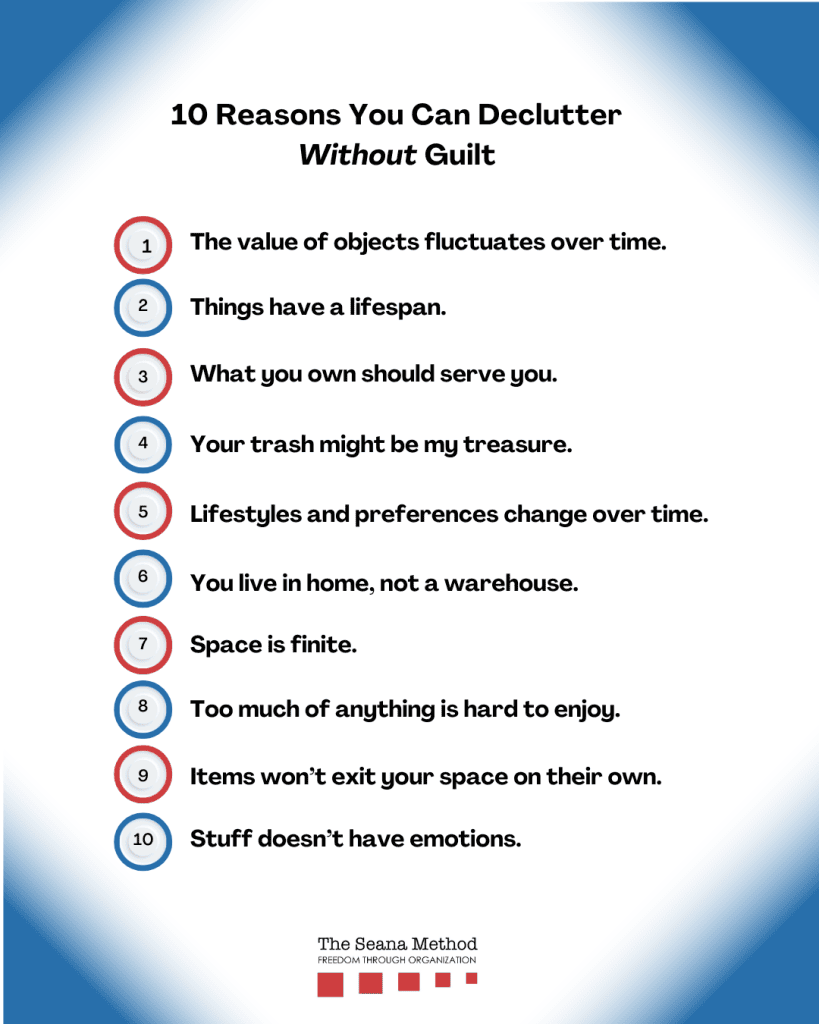
I think we all experience this guilt. That’s why I made a graphic, so it would be easy to save and/or print and refer back to!
This is such a wonderful post. Letting go is one of the challenges that most of my clients have. I love how you broke down these ideas into ten compelling reasons to let go (including the guilt). And your high-level ten-point chart is awesome.
Several years ago, I was engaged in an intense decluttering phase in my pursuit to ‘live with less.” I committed to decluttering and releasing for at least 15 minutes every day for a few months. I kept a chart of what I did, any feelings I encountered, the objects released, and the quantities. Recently, I revisited the chart. And guess what? I didn’t miss or remember any of the items I let go of. That’s not always the case, which is why you wrote this post. But for me, there was zero guilt, no missing what was released, and that feeling of lightness you mentioned.
This is such great testimony. In the moment, we feel that we will regret our decision. In my experience, this isn’t usually the case. In fact, we forget what we’ve let go, or sometimes even feel good when we think about it being used/enjoyed by someone else. I love that you took the time to charge your personal experience, and that now you can speak with factual certainty about how it was for you. Thanks for sharing!
YES, I want a declutter robot! One that does the physical work for me AT MY DIRECTION! Lol! But seriously, I think I have some things in the #2 category (have “lived” long enough) that can go.
If there is someone who can design and build and declutter robot, I’m putting my money on YOU, Hazel! I bet it would be a big seller!!
I love this list, Seana. In some ways we are on the same page today. Decluttering is an important part of caring for your home. Over the weekend, during the ICD virtual event, Dr. Randy Frost shared some truly moving videos made by a person who was having trouble (feeling guilty) letting go of her belongings. He told the registrants that everyone feels discomfort when decluttering their things. If we can sit with the discomfort some time that it becomes an easier task. I think he would love to have your list.
That sitting with the discomfort seems to release some of its power. We try so hard to avoid that discomfort, but if we can face it, we often realize we are stronger than we think. I think it is helpful to know what you point out… that most people have mixed feelings when decluttering. It is normal, and it is possible to prevail!
I love this list! I have clients that struggle with many struggles that you dealt with here. They struggle with conflicting goals. They want a clear living space, but they also want to keep almost everything.
The one that resonates most for me is that my lifestyle and preferences have changed many times over my lifetime.
I see this change in preference and lifestyle in myself. Many of the things that used to be very appealing to me no longer are. A few have stuck, and I’ve started a few new things. Also, much of what I wanted and needed around when I had young children in the house I no longer need. It feels good to lighten up and pass those items on to others who can use them.
Yes, I totally agree. Guilt can really stop people in their tracks. It is so important for people decluttering to recognize their obstacles, without judgment. And, if one needs help with these obstacles, they should ask for help. Getting rid of clutter will not happen if pride or guilt stands in one’s way. Thanks for sharing your thoughts, Seana.
Pride and guilt are definitely hurdles to decluttering. They stop us in our tracks. It’s important to know these hesitations are normal, and also to realize that we can find ways forward in spite of them.
I give away and donate (though so many things are obsolete now, even paper supplies it seems), and recycle what I can, but when doing a major declutter, there’s inevitably something going to landfill. It’s hard for me to accept that, but I admit it does feel very gratifying to see it go!
We’ve made great progress in finding ways to recycle and donate items. Inevitably, some items really are not of use to anyone and should be trashed. In my state, we actually don’t have landfill space, so our trash largely gets “clean burned.” We continue to evolve on this front. Nevertheless, we shouldn’t hold on for that reason only. Not all priorities can be equal, and creating a living space that functions well is worth the effort and justifies some tough decisions.