

This morning, I woke up, came downstairs as usual, and sat at my desk. I heard a scratching, pecking, rustling kind of noise. I thought it might be birds outside my window in the gutter, but when I went outside, there were no birds. So, I came back inside and, after a bit of walking around, realized that there was some sort of creature in my chimney. It must have fallen in and was stuck trying to get out. Since this had never happened to me, I didn’t know what to do. Hmmmm… what to do when you don’t know how to proceed?
Just so you can enjoy the mystery to which I awoke, here is a little clip for your listening pleasure. It really kicks in at around the 15 second point.
I’ll tell you what ended up happening in a minute, but first, the whole event got me thinking about all the times we are faced with perplexing situations. Here are a few that come to mind:
- Long-term projects with unclear steps
- Broken things that we don’t know how to fix
- Failing infrastructure (electricity, plumbing, internet, etc.)
- Unfamiliar assignments and tasks
- Illnesses and physical symptoms that we’ve never encountered
- Chaotic surroundings
- Accidents
- Big Decisions
The common thread here is a sort of “deer in the headlights” feeling. We are overcome with whatever situation is presenting itself, and our emotions can run the gamut from frustration to denial to fear. Under such circumstances, we are prone to freeze up. We may procrastinate taking action because we don’t want to “get it wrong.” Unfortunately, this only adds to the stress, because while we still lack knowledge, we’ve now added time pressure.
Some of you may be thinking, “Yes, but maybe the situation will just resolve itself.” Admittedly, in some cases, this is true. There can be a wisdom in the “wait and see” mentality. However, most people have an inner voice that starts to nag them when it is time to stop waiting and finally do something about a problem. The longer we put off taking action, the louder the voice becomes.
Returning to our question, what should you do when you don’t know how to proceed?
The answer is to do something. Something will get the ball rolling, even if the something isn’t the exact best step.
Let’s return to my “mystery” example. I really felt bad for whatever was stuck in my chimney. The more I listened to it struggling, the more stressed I was becoming. Of course, my husband was on the road, but even if he had been here, he has no more experience in such matters than I do.
So, I reviewed a couple of action-oriented options before me:
- Open the flu in the chimney myself to see what was inside.
- Call the animal control officer at our local police station.
- Call my chimney company to see what they might suggest.
I rejected #1 immediately. Believe it or not, I’ve had bats in my house three times, and I really didn’t want to relive this particular pleasure. Also, if it was a bird or other creature, I didn’t want it swooping into my house. That seemed like another problem I wouldn’t be able to solve.
Since I honestly didn’t know who to call, I decided to call them both. I had to leave messages at both locations.
As it turns out, the animal control officer was the first to return my call. He told me that I needed a specialist trained in wildlife. He gave me two names and number to try, and the first one I called said he could come in about an hour and a half. Yes, this was going to cost me money, but what choice did I have?
To me, the key point was that the first call led to a second call, which led to someone who knew what to do. If I had never placed the call, I would have remained “stuck,” likely with something dead and smelly in my chimney.
It’s very hard to steer when you are sitting still. In contrast, once you start moving, you can pivot and turn as needed until you reach your destination.
Looking back at the situations I mentioned above, here are some examples of actions you might pursue:
Long-term projects with unclear steps
- Brainstorm a list of possible first steps.
- Schedule and take a first step.
- Contact someone who has experience in this type of project.
- Set aside recurring time in your calendar during which you will work on this project.
- Do research on the project with the goal of constructing a plan by a specific date.
Broken things that we don’t know how to fix
- Find out what would be involved in fixing the item (note: this might require a professional opinion that costs money).
- Hire someone to fix the item.
- Do online research to see if you can DIY a solution.
- Research costs and timing to replace the item.
- Make a decision to repair or replace.
- Set criteria and a budget for a replacement, if applicable.
- Go shopping.
Failing infrastructure (electricity, plumbing, internet, etc.)
- Report any outages.
- If necessary, put a temporary “stop” on the problem (e.g., shut off the water valve).
- Clarify if the repair is your responsibility or someone else’s.
- If the repair is up to you, start reaching out to possible service providers.
- Make a list of what you can do while waiting for restoration of service.
- Leave your surroundings to find temporary service elsewhere.
Unfamiliar assignments and tasks
- Identify what you know how to do and what you don’t.
- Ask for help.
- Research this type of task online.
- Put together a list of first steps you can take to move forward and then take one.
Illnesses and physical symptoms that we’ve never encountered
- Decide a time/date by which you will call a doctor.
- Schedule an appointment with your care provider.
- Send a message to your care provider through your portal.
- Head to the urgent care.
- Document your symptoms (take photos, if appropriate).
- If you are in a “wait and see” mode, take daily notes.
- Research your symptoms, but don’t scare yourself. If you find you are getting anxious, contact a professional.
Chaotic surroundings
- Breathe and pursue safe surroundings.
- Contact loved ones to make sure everyone is ok and accounted for.
- Document anything that might be helpful in hindsight, such as damages.
Accidents
- Take a moment to breathe and assess health.
- Document anything that is going on with photos and/or videos.
- If appropriate, contact the police to make a record of the situation.
- If needed, contact health care providers.
- List what tasks you had planned that will now be impossible to complete, and work through the list to make alternate plans.
Big Decisions
- Outline the various choices before you. [I frequently say, “Everything is easier in a matrix.” If you can put your options into a spreadsheet or chart, I highly recommend it.]
- Invite people you trust to offer advice or perspective.
- Research your options, noting areas where the choices are truly different.
- If applicable, visit locations or meet with potential stakeholders.
- Set a deadline for making a decision.
These are just a few suggestions. The idea is to just do something: make a call, contact a professional, follow through on one next step, etc.
“The first minute of action is worth more than a year of perfect planning.”
James Clear
One note: while I’ve listed research as an option, remember that we can easily spend too much time on this step. We can “spin in indecision,” and the more research we do, the more overwhelmed we feel.
Which leads me to a second important point: limit your choices.
One of the main reasons that we struggle with knowing what to do is that there are too many possibilities. When we have too many choices, we are tempted to do nothing. Therefore, regardless of your situation, refine your list of “next step” choices to no more than three options. I gave myself three choices this morning, and then took action on two of them. This felt manageable. My daughter recently had to select a wedding date and venue. Her Dad wisely suggested, “Winnow it down to three venues, and then check availability. Otherwise, you will drive yourself crazy.” He was right. [Note: she has since made a decision – so fun!]
So, are you wondering what happened in my chimney?
The wildlife expert came in, told me to open my sliding glass doors, and then proceeded to investigate. Apparently, raccoons can escape from chimneys, and bats are silent, so he was guessing I had a bird. One type of bird – a chimney sweep – can also escape, so it was probably a different type of bird. I agreed, as I had heard what sounded like pecking with a beak and a fluttering of wings
Turns out, it was a woodpecker. Poor little guy.
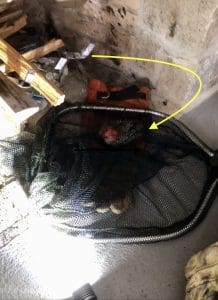
He caught the bird in a net and released him into the backyard. Amusingly, he almost flew back into the house, probably because he had soot in his eyes. Fortunately we were able to quickly shut the door and encourage him to fly in a different direction.
The wildlife expert told me he had once had a similar moment when he captured and released a bird who flew into a nearby bush, only to have a huge hawk swoop in and grab him. Now THAT is what it means to have a bad day!
* * *
All of us land in circumstances where we don’t know what to do. It’s just a part of life. The key to moving forward is to make a plan and take some sort of action. Will we always make perfect decisions? No, and that shouldn’t be our expectation. Most important is to acknowledge that the “weight” of indecision and inaction is heavy, and to believe that relief is possible.
Are you facing an overwhelming situation? What tip can you share from your own personal experience?


I was right! (About what, specifically, was in your chimney.) And pretty much everything has been overwhelming for me for awhile now. In every category you listed. A few big issues have been resolved, though, which makes some of the smaller issues seem more doable. (Fingers crossed that nothing else major comes along anytime soon.) And I definitely have to write it all down so I can keep track of who I’ve called, and what I’ve tried, and what still needs doing or fixing. Also to help distinguish what is my job, and what isn’t, to fix. Thanks for the clear lists of ideas, Seana!
Isn’t it funny how those “overwhelming” things tend to come in groups? You got awhile with everything humming along, and then things start going haywire in multiples! May you have no further issues, Hazel. It’s a job just to keep track of it all!
Wow! What a story of how life happens! That is what might be happening to many of us right now. We get stuck for lack of skill or knowledge, but also because of emotions.
Here in Houston, we have been faced with “what to do next.” Because of the recent hurricane, there have been trees falling on homes. Some of these are 40-foot trees are perched on the top of people’s homes. We have used crowd-sourcing as a way to find contractors to help. The resources have included chain saws, cranes, and chains. It is a lot to fathom what steps were needed to help. Relying on each other, gathering resources, and making decisions is what these families have been able to do because of our community who support each other in these emergency situations.
What an immense difficult you and fellow Houstonians are facing. We have had similar situations up here. I remember saying, “I sure do love the sound of a chainsaw,” when someone showed up to cut a tree that was blocking our ability to leave our street. Trees are a huge issue in storms up here in CT. You are also facing heat and other challenges down there. I pray for all to find the needed resources to help speed the return of life to normal. Natural events are quick reminders of how out of control we actually are. Humbling. Sending a hug to you, Ellen!
Thank you for going through your thought process for your unusual situation. I’m glad your story had a happy ending. You found an expert to help. He figured out what to do and successfully released the woodpecker into the wild. When I listened to your video recording, I thought it might be a woodpecker. That tapping sound was familiar.
Several years ago, I had a similar situation. Some animal found its way into our bedroom. It turned out it was a chipmunk. My three ‘panic’ calls (in this order) were to my husband, the local police, and the wildlife guy. At first, I wasn’t sure what to do or who could help. All I knew was I needed help immediately. Thankfully, the wildlife guy calmly fixed the situation, skillfully trapped the little critter, and released it outside.
There are numerous situations when you get stuck and need help moving forward. Your list of suggestions is so helpful.
Congratulations again on your daughter’s engagement! How wonderful that she found and secured a venue. Your husband gave her such sage advice about limiting her choices.
We’ve also had the chipmunk situation. It’s crazy, right? You don’t want to hurt the little guy, but he can’t stay LOL! Glad you found a resource to free him. I’ve been surprised how many times I’ve placed a call to the animal control office in our town. You’d think I was living in a jungle sometimes!
We are always thankful for my husband’s wisdom for bringing clarity and boundaries to complex situations. This is definitely one of his gifts!
It really is such a good topic – how often do we have situations we don’t know how to tackle. A lot! I tend to get some paralysis at times, and other times I am incredibly cool-headed about chaos. The smaller things paralyze me and the larger things make me calm. I guess it’s weird but I’d rather it was this way!
We had a chipmunk in our chicken house causing mayhem to our dogs. They were obsessed! And he/she was bothering the chickens. My solution was to let the dogs chase it out. I didn’t know what else to do. And then hope for the best. My husband’s solution was to close and block the door with the dogs in it, so the chipmunk couldn’t escape. We’re very different people! I don’t want a dead chipmunk to clean up – then I REALLY wouldn’t know how to proceed.
Isn’t it crazy to see what kinds of situations we find ourselves in? We had a chipmunk in our house. Our dog went crazy and it was wild for awhile. I think everyone was afraid LOL!
You never know what the day will bring, but most of us do face days that have some “tough stuff” to deal with. If nothing else, this post reminds you that you are not alone!
I admit that when I’m in a dicey situation, I usually adopt a “wait and see” attitude, but this isn’t always wise. A few weeks ago my husband had stomach pains and I was sure it wasn’t serious but ended up calling an ambulance – it turned out he needed emergency surgery. I was very glad I didn’t wait and see that time!
The steps you outline are excellent and I’ll be pinning this post for further contemplation.
Oh my goodness. So scary! I hope your husband is doing well now. It’s hard to know when a medical situation is an emergency and when we should wait and see what develops. Even putting a time boundary on the waiting is one form of action!
My son is dealing with something of an animal problem right now. The house next door is being renovated. The family told my son, they had a mouse problem. My son heard them but didn’t think anything of it until the mice left the home that’s undergoing a major renovation and moved into his house. My son is resisting calling the experts. He’s all about DIY and is struggling. Some of the stories he tells me sound like they belong in a Tom and Jerry Cartoon.
Back to your blog – I love the way you outline the steps people can take.
In particular, your point about limiting your choices is something to take to heart. When we are presented with lots and lots of options it’s difficult to pick one.
Thank you for sharing your story and your wisdom.
Sorry for your son and his mouse problem. Mice are hard to get rid of. In fact, I’d say many people around here have mice now and then. I hope the problem doesn’t grow. I have someone come quarterly to help keep our mouse problem at bay.
Limiting choices is everything. We can only process so much. I think many professional and experts add great value in this respect!
I’m glad you found a solution. Just asking questions gets me out of the stuck mode or the deer-in-the-headlights feeling.
Last week, we were out of power for 16+ hours. My husband was not around, and he was the one who would tell me what we needed to do.
Luckily, a few years ago, with all the storms and outages we had, we decided to document a “what-if scenario” list. I included what-if scenarios, such as if the power goes out and there is a clog in the main drain. Plus, the steps of who to call for service. I’m so glad I had this document because after doing a few turn-off items, I decided to make my life easier and reserve a room at the nearby hotel. It was during our excessively hot days, so I didn’t want to stay at home during the day. I figured that if the power went back on, I would lose $150, but I didn’t care. It was better than moving a generator that weighs a ton and hooking up all the appliances by myself. The power turned back on, so I waited a bit and then canceled my reservation. I also realized that my refrigerator (if not open) can keep things frozen and cold for 18 hours. Yay, so no lost food.
Extended power outages are a great example of when we might not know what to do. Good for your family having this “what-if scenario” document. We get used to leaning one member of the family to solve problems, but as you point out, if that person is not available, the task of finding a solution may fall on us. It’s great that you thought to get the hotel reservation. Sometimes taking a precautionary step is the best immediate action. Then you can “wait and see,” knowing you have a plan.
This is excellent Seana,
These kind of situations demand that we get motivated even though we don’t feel like it. I had a bird in my chimney as well and had someone come out to get it. It was a grackle lol
My guy opened something up, grabbed the bird with a towel and we watched it fly off. I love all of your suggestions and thought process of tackling a hard situation. It sometimes feels easier to do nothing, but in the long run you can end up with a bigger problem. Great post!
Wow, an easy grab with a towel. What a guy!
This is one of those problems that I just couldn’t do nothing about. Worst case, I was going to end up with a smelly dead “something” LOL!
I loved your comment, “It’s very hard to steer when you are sitting still. In contrast, once you start moving, you can pivot and turn as needed until you reach your destination.”
When to act and when to wait can be a difficult decision.
I recently was diagnosed with Atrial Fibrillation with Rapid Ventricular Response. I was given an appointment 5 days away to have a Cardioversion that would shock my heart back into rhythm. Meanwhile I was told that if anything seemed life threatening, I should go to Emergency Care. Having had experience in the Emergency Room before with my husband I know this can be a 12 hour stay.
I waited it out, but it was scary at times.
That is a scary wait. I’m sorry to hear about your diagnosis, and hope the procedure brought the needed relief. Medical issues are especially difficult because making the wrong decision can have dire consequences. Sometimes just setting a limit for how long you will wait is a type of action, right?
Yikes! I hate that you had this experience, but you’ve laid out a fabulous guide for people facing all kinds of “Yikes!” circumstances.
I live in an apartment complex, so I’m lucky that when things inevitably go wrong (birds in the chimney, air conditioner dying, a leaking roof during a rainstorm after a tornado tore off roof tiles), I know that the most urgent thing is to call maintenance for help. If I were a homeowner, I know I’d be more likely to have an A/C guy’s number handy, but less likely to have a chimney sweep or roofer.
This post reminds me of problems where I’ve initially freaked out, then taking a deep breath, just in the past year. Last August (as you know), my car was stolen. In April, someone smashed in the window in my car (and about a dozen others in the parking lot). Police-insurance-repair place/glass place —> I’ve got the next step down pat.
But smaller, wonkier things? I had to remove the old DVR and attach the new one last fall, and I was sure I could do that because it’s a matter of just unscrewing some things and re-screwing in other things. But the last cable guys had tightened the cable at the splitter so tight that it would not come loose, no matter what I did. I brainstormed. I called the cable company for *advice*. Could I use WD40? Was there a trick to getting it loose. Unfortunately, the phone rep was straight from central casting from a Saturday Night Live video and was of no help; she could understand the problem for about 10 seconds and then would forget and think I needed help programming my DVR. This happened over and over. Finally, I called one of my best dude friends and asked for his help, texting a photo of the layout. He asked if I had a screwdriver or something similarly flat; I knew immediately what he thought I should do, and even quoted Archimedes to him: “Give me a place to stand, and a lever long enough, and I will move the world.” Unfortunately, I just managed to break the splitter! Then I sought the work toolbox of my downstairs neighbor, figuring he had more sizes of wrenches. No luck. In the end, I tried some WD40, and low-and-behold, off it popped in seconds. Oy. Still, I think the answer is always to seek help and advice, between two heads (even when one belongs to a numbskull cable rep) are better than one!
BTW, I had to watch twice; I was distracted by photos in your fireplace! 😉
Hard to avoid the reflection of photos LOL!
I’m laughing as I read your story. When all else fails, I find Gorilla Glue or WD-40 to be common solutions LOL! What a hassle. Who would have thought that you could even break a splitter?
The car hassles, on the other hand, are just not funny. Scary, upsetting, highly stressful situations. I hope that never happens to you again. We have a lot of break-ins in my town. They used to just go after unlocked cars, but now that people are locking their cars, they are breaking windows. It feels like such a violation. Between that and the theft of catalytic converters, protecting your car has definitely gotten harder.
I often see clutter in client’s homes has everything to do with the fact that they just don’t know how to proceed. It’s usually an item that they think may have value. So we talk about how they need more information to proceed to a decision. Can they look the item up on eBay to see what similar items sold for? Are they willing to pay someone to sell it for them (how much will it cost?) or are they willing to sell it themselves? Getting more information is a good way to move forward and know how to proceed.
Completely agree that getting more information is a huge help. Sometimes, people just don’t know how to get that information, and that is where professionals can come in handy. I also encounter that issue with clients, and often we find out it isn’t worth the hassle of trying to sell their item.
This topic couldn’t have come at a better time for me. My husband is having his third medical crisis in 1 1/4 years which has put me in charge of everything and led to anxiety, exhaustion and overwhelm. I’m dealing with nearly all of the items on your list of perplexing situations.
I will refer to your breakdown of possible actions as needed. Just seeing those suggestions written down in black and white is somewhat calming.
Thank you.
Oh Carolyn, my heart goes out to you and your husband. So many medical situations are overwhelming and exhausting. You hardly have time to recover from one before having to navigate and deal with the next one. Sending you a hug, and hoping these suggestions make things a bit easier. One day at a time!
You are so right! Getting started is the hardest part and narrowing possibilities is a good start. It’s so easy to procrastinate but some things demand immediate attention. Glad you got the poor bird out of your chimney. You were good to come up with ideas on where to start. Great tips on handling these situations!
I’m glad we got him out, and in one piece. I felt bad for the little guy…
When faced with uncertain or perplexing situations, it’s easy to feel overwhelmed and stuck in indecision. However, taking even a small action can help you gain momentum and lead to a solution. Whether it’s making a call, asking for help, or breaking down the problem into manageable steps, forward movement is often the key. We don’t always need the perfect plan, just the willingness to start.
There is incredible power in taking that first step. It unleashes a whole plethora of possible doors. I’ve been stuck in indecision for a variety of reasons. There is a time for planning, and then there is a time to just do what I can, take that tiny step, and then see where I can go next.