
Do you have a daily task list? How many do you actually complete? Do you like some more than others? What’s the best type of task?
If I asked, “What’s your favorite kind of task?” you might say:
- A task that is fun.
- A task that is easy.
- Something I don’t have to do.
- The task that I can do quickly.
- A task that gives me a great feeling when it’s done.
- Something that I get complimented for doing.
- A task I can complete without needing anyone else.
- A task I remember to do.
These are all fair answers. I enjoy quick, easy wins as much as anyone. There’s a certain satisfaction in knocking out several tasks in a short burst, such as running errands, where a few stops can turn into a long list of checkmarks. Of course, we all face tasks we’d rather avoid. If I asked about your least favorite, you might say:
One that is difficult (physically, mentally, or emotionally).
- A chore that is boring.
- A task I don’t know how to do.
- A task that I feel I don’t have enough time to successfully complete.
- Something I have to work on with other people, especially people who are critical, impatient, bossy, or disinterested.
- A task that has to be endlessly repeated.
- An invisible task that requires a lot of effort for little reward.
- A task I know will be criticized, regardless of my effort.
- A task I forgot and now have to go back and do.
- A task I am avoiding.
All of these reactions make sense. Recently, I worked with a client on paying her bills. She felt overwhelmed by the volume and just wanted it done. I validated her feelings, because much of what we do in life simply isn’t fun.
When faced with a list of “undesirables,” it’s easy to slip into avoidance or disengagement. We start longing for escape–or even retirement. But eliminating tasks altogether isn’t a path to happiness. Why? Because there is great satisfaction in completing things, especially if we do them well. Using our gifts and talents meaningfully is one of the pleasures of life.
I’ve spoken with retirees about this. While reduced pressure can be a relief, too little to do can create its own problem. Without purpose, identity can erode. Even hobbies can start to feel like obligations when they become the main structure of your day.
The challenge, then, is to more closely align what you have to do with what you want to do.
Let’s consider a couple of possible strategies.
Manage Your Expectations
If you expect your tasks or your job to feel fulfilling, you’ll likely be disappointed. Work (paid or unpaid) is called “work” for a reason. Most people have to do a bunch of stuff that isn’t particularly appealing. That’s just life.
Social media and braggadocios friends/coworkers can make it seem like everyone else is constantly fulfilled and productive. They’re not. Don’t add unnecessary pressure by comparing your reality to a highlight reel. Instead, cultivate a positive mindset toward the tasks you need to perform.
Build in a Sense of Accomplishment
Most people long for affirmation and recognition of effort. It makes us feel good when someone notices what we’ve done or gives us positive feedback. Sadly, much of what we do will go unacknowledged. Sometimes, it will be criticized.
It is important to find ways to generate your own sense of accomplishment. Set goals you can be proud of achieving, whether that’s sustained focus, finishing a specific number of tasks, or finally tackling something you’ve been avoiding.
Since you have no control over external validation, it’s wise to minimize its importance in your productivity.
Get Yourself Started
The best type of task is typically one you actually complete, and you can’t complete a task without first beginning. Many people struggle with initiating tasks.
The onus for getting started will typically fall on you. There is no shame in doing whatever it takes to get yourself started, including:
- Setting an alarm to remind yourself to take action.
- Paring down a complex task into small, low-barrier-to-entry pieces.
- Asking for help when you don’t know how to begin.
- Seeking accountability from another person who, at your request, will check in to make sure you are following through.
- Setting a timer for how long you will require yourself to stay focused.
- Moving yourself into a physical setting where it is easier for you to work on your task list.
- Taking medication (under medical supervision) that helps you focus.
Arrange Tasks in Priority Order
Checking off a bunch of tasks feels good, but it won’t feel great if the most important ones remain untouched. As you consider what needs to be done, ask yourself, “Which of these will I feel best about completing?”
Candidates for top priority tasks include:
- Things with a near-term deadline
- Tasks that others need me to do in order to complete their tasks.
- Things that impact physical health, of you, or others who depend on you.
- Chores that will be expensive to avoid.
- Tasks you need to get done before you can move onto a next step.
I’d like to say start with what makes you happy, but this approach may result in avoidance of what is truly important. At the end of the day, you want to feel like you used your time as wisely as you could.
Also, as you consider where to focus your energy, remember that no one sustains peak performance all day. The point of setting priorities is to make the most of the time and energy you have. Typically, this will look like an ebb and flow of effort over the course of a day, tackling the hardest tasks when you are most alert.
Eliminate What You Can
When our task list feels overwhelming, the first step is to cull whatever you can. Just as a room can become overrun by clutter, a list of chores and appointments can be overpowering. In fact, sometimes its enormity can be paralyzing.
This situation can have many causes, and it isn’t a simple problem to solve. It’s not like you can just tell your baby to change her own diapers or tell your boss that you are opting out of performing certain aspects of your job.
The most effective strategy I’ve seen is to be as ruthless as possible in removing anything unnecessary. For example:
- Resign from volunteer commitments that have become burdensome.
- Ask for help (don’t assume anyone notices you need it).
- Hire help if you can afford it.
- Delegate what you can to others.
- Set aside extracurricular activities that are taking too much energy.
- Declutter your physical belongings to make it easier to work in your space.
- Simplify wherever you can (outfits, meal plans, etc.)
Remember, some stages of life are more intense than others. Just because you choose to remove an item from your list today doesn’t mean you will never return it, only that you don’t have time for it right now.
Focus on the Future You
A good task is one we complete. However, often we don’t feel that sense of satisfaction until a point in the future. In the current moment, all we see is work.
I loved this graphic I saw on social media.
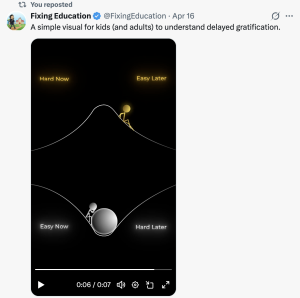
It highlights a simple truth: we choose our hard. Do we want to do the hard thing now or later? One takeaway from this graphic for me was that when I choose the “Easy Now” option, I am not only postponing the hard part to the future, but that I may have to dig out of a tough position to get going. The “starting point” can be tougher the longer we wait.
When we are waffling on doing a task, it helps to focus on how great it will feel in the future to have it completed. For instance:
- Have the coffee pot set up and ready to go when you come down in the morning so all you have to do is push “start.”
- Reset objects in your space before you leave the house, so it feels orderly and inviting when you return.
- Triage the mail as soon as you bring it in so it doesn’t build up.
- Knock out your toughest task early in the day so the day gets easier as you go along.
- Schedule your “extras” on Mondays or Tuesdays so the week gets less stressful as the days unfold.
- Run the errand while you are out so you can relax when you get home and not feel the pressure to go back out later.
Celebrate Showing Up
Wouldn’t it be nice if every effort we made had a successful outcome. If we could point at a task and think, “That went so well!” Unfortunately, this won’t always be the case. Sometimes our efforts won’t go as planned. In other cases, we may get pushback or criticism. Often, the impact of our efforts may only become evident over a long period of time. It’s easy to become discouraged.
I encourage clients to value effort over outcomes. Effort is within your control; results often aren’t.
The best tasks are the ones you do. You may not be perfect, but you show up. You may not feel like doing them, but you do them anyway. When you show up, you prove to yourself and communicate to others that you are reliable. Showing up builds confidence. It empowers.
* * *
The ability to take action isn’t a burden, it is an opportunity. Which tasks would you describe as your “best?”


I like to think of the smallest step possible for a task. With each step along the way, you could might feel overwhelmed and burdened as you check on each task. Keep a task as small and simple as possible, you can be sure to move forward.
I like those small steps too! When I’m really resisting doing something, I ask myself how I can make that first step smaller. Sometimes it is even laughably small, but hey, if that works, why not?
I love the way you approached this topic. Pausing and reflecting upon what task we are moving toward and which we are moving away from brings awareness. Then we can attempt to reframe or try some of your amazing strategies.
Being an organizer, I have thought a lot about my tasks and discovered that I had a ton of anxiety toward them because I had undiagnosed ADHD throughout my childhood and early adulthood. It was hard for me to focus and pushing off tasks caused a lot of shame. Sometimes, my first reaction to a task is to return to that feeling of anxiety. But then I remember that I have lots of tools in my toolbelt that I can use and that I don’t have that same relationship with tasks anymore. I try to bring this mindset to my ADHD clients. Thank you for your refreshing and helpful post on this topic.
I am such a huge fan of tools. I talk a lot, with myself and others, about the value of investing in and using our tools. They aren’t a sign of weakness, but instead examples of wise choices, things we employ to make us productive. I don’t know why we feel shame about productivity tools when we often brag about tools we use in other areas. If only using productivity tools would become cache!
Excellent. Yes, when something overwhelms me, I think about the smallest thing I can do to start. A simple example: put the bill I’ve been dreading paying on my computer desk, put the credit card on the desk, boot up the computer . . . . Seriously, sometimes I have to tiptoe through tasks.
Me too, Cathy. Some tasks are just hard to initiate, and in those cases, the littles step is the only way to get myself going!
I love this post, Seana! I have organized tasks by time instead of by project. To do this, I start with my 15-minute tasks. These can be done at any time throughout the day and week. The next tasks are errands. I ordered these tasks in the order of easy travel. So, I can get them done when I go out. Then, there are the larger tasks that may take a few hours or more. These are time-blocked into my day to help stay focused.
Oooh, I love this approach. It really focuses in on the connection between the time we have the things we need to do. I love this approach!
This is a great topic to dissect, Seana. Any task can be onerous – even the smallest, least consequential ones. The longer we think about the tasks we don’t want to do, the more onerous they become. I try to get the ones I don’t want to do over with first, even if all I do is one small part of the task – at least I have started. That always leads to the next step – which, honestly, can be not so much fun also but I’m moving forward. The other thing I do for myself is promise a reward. My reward is usually to sit outside and read or do some gardening – 2 of my favorite things.
I love a self reward. That celebration matters. We need to pause and affirm ourselves if we want to be productive over the long haul. Now if it would just warm up long enough, I’m itching to get into my garden up here too!
My motivation for doing tasks that I would rather not do, is the knowing how I’m going to feel later. If the task is completed, I’m going to feel more relaxed and pleased. If the task is not completed, I’m going to feel stressed and like I have failed. I often think about how my future me is going to feel.
One of the reasons that I love my routines is that I do not think about when I am going to do certain reoccurring tasks. I just automatically do them as planned.
My best tasks then are the reoccurring ones.
What a great response:”My best tasks then are the reoccuring ones.” This statement has power. What else can I build into my routine, right?
I can relate to this, especially “Even hobbies can start to feel like obligations when they become the main structure of your day.” This happened to me recently. For years, I’ve been participating in various daily and/or weekly photo challenges, and for quite a while they were a great way to keep me engaged with my hobby every day, even when it meant posting an archive photo instead of one taken that day. Eventually though, it often felt like just one more thing to check off my list. I’ve now set my own challenge to take at least one photo every day which I’ll add to my diary app. After that I’ll only share it on social if I think it’s worthy, and keep it if I will appreciate seeing it again. Otherwise, I delete it. Not only has this removed the burden of doing what was starting to feel like homework, it means I have a lot less photos to organize at the end of the month!
I see this happen a lot. When our fun becomes our work, it’s worth pausing and assessing what is going on. I love the way you pivoted with your photography habit. It should be fun1
I find the everyday tasks that are repeated over and over easy to do but the challenging ones I tend to procrastinate on. Getting started-no matter how small the effort, is the hardest part of a challenging project-one that you don’t have to do but really want to accomplish. I’m tackling one which is difficult for me to do but I want done. I’m making some progress. I like your approach.
I’ve just been reading a book that talks about our automatic behaviors, and how these are easier and save us mental energy. Makes sense, then, that our repeated behaviors feel simpler to get done, right?