
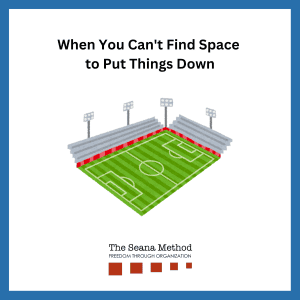
Football season in the US is in full swing. I’m not a huge sports fan, but I do enjoy relaxing in front of a television on a Sunday, cheering my favorite team. (Go Birds!) It’s fun to watch the players take the field and use their gifts and talents in pursuit of victory. In all my years watching, there’s one thing that I have never seen. A football field covered with objects. Can you imagine players trying to play football on a field cluttered with furniture, paperwork, toys, books, memorabilia, food, and tools? The image is laughable. And yet, many people try to do this very thing! We attempt to perform in spaces that are crowded with belongings and then feel bad about ourselves when we don’t ‘win’ the game either. This is frustrating and unproductive. Instead, when you can’t find space to put things down, it’s time to reclaim your space.
Your Work Surface is Your Playing Field
Let’s build on this idea of your space as a playing field. Your work surface is the equivalent of your playing field. This might be:
- Your desk
- The floor
- The kitchen counter/island
- The bathroom counter
- A workbench
- Your bed
- A kitchen or dining room table
Many tasks utilize multiple work surfaces. Clear spaces invite productivity, while crowded spaces tend to feel overwhelming and unpleasant.
When Your Field is Crowded
What can happen if your work surfaces are covered up with backlogged possessions?
- You can’t spread out the supplies you need for the task at hand.
- You struggle to complete tasks in a quick (and ergonomically efficient) way. For instance, you may resort to carrying your laptop to the couch, which isn’t good for your back.
- You lose track of things that get covered up by other things, especially if several days have passed. This forces you to waste time trying to find what you need.
- You may trip or bang into things as you try to move about your space.
- You may damage things as they fall to the floor, get stepped on, become stained, get wet, etc.
When your field is crowded, you can’t play your best game. Trying to be productive in the midst of a mess is difficult at best. Some tasks become almost impossible to perform in a crowded space. For example, you can’t cook in a kitchen whose counters, sink, and island are filled with stuff. You need room to pull out the food and utensils so you can safely and hygienically chop, mix, assemble, and cook.
The Field vs. The Locker Room
I’ve talked about how football players need a clear field to play the game. Of course, football also requires a lot of gear: pads, uniforms, cleats, balls, sweat towels, water bottles, etc. Players also train with hurdles, cones, agility ladders, weights, and more. Nevertheless, you never see this stuff on the field when the game starts. So where does it go?
The answer is to a storage location:
- Weights and bands are stored in a training room.
- Towels, uniforms, and cleats are stored in a locker room.
- First aid supplies may be in a medical room or medical bags.
- Training supplies are stored in a supply bin, shed, or closet near the practice field.
At any given moment, some of these items may be pulled from their storage location and brought to the field for use. However, at the end of the game, they are removed from the playing field and returned to their designated storage space.
We should be doing the same. When we are working on a project, we are in the middle of “playing the game.” We might pull out electronics, paper, writing supplies, cookbooks, tools, study materials, or any number of items that we need to complete our task. Then, at the end of the work session, we should clear our field and put things away. Yes, a few items may stay out; it isn’t necessary for every work surface to be completely empty. However, as little as possible should be stored on a work surface. Again, your work surface is your playing field. The less that is there, the easier it will be for you to get things done and win the day.
Putting Things Down
Not being able to put things down is a “red flag” that you need to take action. Remember, the goal is not simply to clear space so you can put more stuff down. The goal is to clear surfaces onto which you can temporarily place items needed for the task at hand. Equally important is to designate where everything will go once your work session is over. In other words, at the end of your “game,” where will you put things so that your surface is clear and ready for next time?
Before moving on, I want to acknowledge that I fully understand that people differ in their preference for how to store things. Some people like having everything out where they can see it. Others prefer things tucked away behind closed doors. Both of these approaches if managed well, can work just fine. What you do not want to do is haphazardly sweep everything off your table or counter into a container. This only creates a future project: sorting through the clutter.
Instead, as you approach time to wrap up your “game,” sort your items by type. Ideally, you want to have containers that will keep everything separate. For instance, put your pens in a cup, sort papers into folders, put tools back into your box, etc. Then, take a few minutes to return your sorted containers to their storage spot–whether inside a concealed location (e.g., closet, cabinet, file drawer, etc.) or out on display (in piles on a credenza, on a storage cart, hanging on the wall, etc.).
Clearing The Field FAQs
Q: Where do I start?
A: Identify what “field” you most want to clear. Where are you most struggling to get your work done?
Q: What should I remove?
A: Everything! Start by taking everything off of the surface. Move it to another surface where you can review it. Afterward, it’s a good time to wipe the surface clean. Throw away trash, and sort what is left by type of object. Carry anything that belongs elsewhere to its proper location. Then, consider what you are willing to have take up space on your playing field. I encourage you to be very picky about what goes back. Each object should justify its place on your workspace. Think about trying to keep a clear playing field.
Q: Where do I store the things that I don’t put back?
A: I’ve written many posts about where to store things on this blog. I’ve also looked at spaces like the kitchen, bedroom, entryway, desk, home office, and more. I also ran a 30 day video series on where to store common household items, which you can see here. The general rule of thumb is that the more you use an item, the easier it should be to access. For example, if you use a stapler every day, it should be in a top drawer. Files you are keeping “in case you get audited” can be stored in a box in a remote location.
Q: What should never be stored out on a work surface?
A: Anything you are keeping for archival, decorative, or sentimental reasons is best stored somewhere else. Yes, you might like that family photo, but you can hang it on the wall near your desk rather than keeping it on your desk itself.
Q: How do I keep my surface clear?
A: There is no magic bullet here. The only solution is to build in time, at least once a day, to re-clear your surface. It’s the routines we repeat every day that end up making the biggest difference in our lives. The longer you postpone clearing your surface, the more time and energy it will require from you.
* * *
Which surface in your space is your most productive? Do you keep it clear?


I love this analogy! How valuable to help people understand the value of organizing and how it helps you every day!
Here’s to a happy season of clear football fields and clear work surfaces!
What a wonderful analogy! I love how you connected the concepts from football fields and locker rooms to organizational systems. It’s unique and so powerful.
Judith Kolberg has developed many practices that connect relevance from another concept, industry, or experience to the organizing process. One of those is an editing process called “Friends, Acquaintances, or Strangers.”
What you created here reminds me of her techniques. What makes it so powerful is tapping into an understanding of something else to apply to an area of life (organizing) that may feel confusing, emotional, or overwhelming.
I love Judith’s “Friends, Acquaintances, or Strangers” approach. A metaphor can help us think in fresh ways, right?
Your FAQs are terrific, Seana. I love this analogy. You are so right a clear field makes work easier to complete. Resetting the space once the work for the day is finished is so important. Building the time to reset the space into the time allotted to work helps me stay on track.
Thank YOU for inspiring me to give FAQs a try. I really enjoyed them on your posts. 🙂
My desk is my most productive area in my home office. And while I try to clear it at the end of every workday there are times when I just stack the items I am working with and plan on working on it the next day. I also have a habit of laying out ongoing projects on a couch in my office rather than going the extra step of putting them away in project bins. This visual clutter annoys me, so it doesn’t stay there too long but sometimes longer than it should.
I think you are touching on an important point here, Jonda. If the visual clutter bothers you, this can be a way to force yourself to deal with a task or supplies. In contrast, if the visual clutter does not bother you, then it is likely to accumulate.
Knowing our own proclivities is important for helping us to put in place appropriate accountability and stimulus to action!
I learned this when I worked for a company that had a strict clean desk policy. When you left for the day, the only things allowed on your desk were your phone, your in-tray, and your large calculator. Once they actually removed everything else and stashed it away for a long time, until a staff member discovered the hiding place. Obviously this was many years ago, before everyone had a computer!
This policy seemed like a pain in the butt, but it taught me to appreciate starting off with a clean work surface, and though I’m not quite as strict as that, there’s rarely anything on my desk except my computer and monitor, my phone, and two ceramic vases – one holds pens and pencils and the other holds scissors, a letter opener, a utility knife, and a Sharpie for crossing my name and address off packages before I recycle them. Everything else is in a desk drawer.
I didn’t like that job and stayed for less than a year, but it’s good to know I got something out of it!
I’ve never heard of a company doing that. Wow! It forced people into a behavior, which I don’t think really ever works. I think an employer might be better to try it for a week and then see ask for reactions. I imagine some people just shoved everything into drawers at the end of the day, which might have ended up backfiring.
That said, I remember my first real job, and how the boss’ desk was always quite clear. He brought out what he needed, but it all got cleared up at the end of the day. It made him seem very much in control, I have to admit!
Great analogy! What a great way to relate to sports enthusiasts. I’m not a big sports fan, but I have had clients who were and found that they loved using terms like “pitch-it” for trash it. Lol – I loved it. Thanks for sharing your thoughts. It’s always fun reading your posts. =)
Love when a good analogy gets us thinking in fresh ways!
I agree with everyone here who says “great analogy”. But, after all these years, I think it’s time we recognize you as the Queen of Analogies! And yes, OK, OK, I have a few surfaces that have gotten out of control that I need to address. Thanks for the pep talk, coach! 😉
I do love a good analogy LOL! I guess this is how my brain works. “Pictures” help me think about situations in a way that is a bit different than just words.
I’m cheering you on over here as you tackle those surfaces, Hazel! (I was a cheerleader, so you can picture me with my pom pons shaking, right?)