
Have you ever walked into a familiar space and seen someone sitting in your seat—or your parking spot? Has your regular route to work ever been blocked? Most of us encounter these frustrating moments. Here are my thoughts on how to overcome these disturbances to your routine.
The Bad News
First, the bad news. Interruptions to our routine often cause us to blow our cool. I describe these as disturbances, because while they don’t necessarily prevent us from completing our tasks, they make it harder.
For example:
- A blocked road means we have to find a detour.
- Someone in our parking spot means we have to find another one.
- If a store doesn’t have the item we need, we have to find a substitute or go to another store.
- A surprise visitor at the door makes us late for an appointment.
- A power outage means we have to find someplace to access WIFI so we can do our work.
- A medical situation makes it hard to focus and might require a trip to the doctor.
- A chatty person in the seat next to us on the plane or train interferes with catching up on our reading.
Finding new approaches, on the spur of the moment, takes energy and time. This isn’t just a matter of us becoming annoyed by “the little things.” Instead, we are having to deal with the fact that everything we have to do is going to be more difficult.
The Good News
Second, the good news. The fact that these disturbances upset us so much is proof that we have a system. Perhaps we’ve put together a well-thought-out plan for the day, and these interrupt the plan. Or we can’t go through our routine as efficiently as we had planned.
In a previous post, I talked about the power of habits. Routines and habits generally make tasks feel easier:
Small, consistent choices also have power because they turn into habits. When we make “new” decisions, we employ the frontal cortex of our brain. This requires energy and focus. Remember back to when you were learning to drive. It required great concentration to start the car, shift into reverse, and then slowly back down the driveway without hitting the nearby wall and trees. However, once a skill is achieved (and a habit is a skill!), the brain efficiently takes our acquired “how to” knowledge and shifts it back to the basal ganglia of our brain. This way, we don’t need to stop, focus, and exert energy over and over again. As long as we do things the same way, the brain shifts to “auto-pilot” and takes care of it. If you’ve been driving awhile, you are probably able to back down the driveway while changing the radio station and talking to your children in the back seat. This is an amazing characteristic of the human brain, and one that helps us be more and more efficient as we progress through life. [from The Impact of Small Change]
While habits are productivity superstars, they do have a downside: the stronger the habit, the more upset we will get when they are disrupted. We can’t rely on that “automatic” mental processing and instead have to reengage our pre-frontal cortex to figure out next steps.
Dealing With Disturbances
Fortunately, productivity doesn’t have to be an all-or-nothing game. With a little flexibility, some mental reframing, and a few practical strategies, we can still get meaningful work done — even when our day doesn’t go as planned.
1. Accept, Don’t Resist
The first and most important step? Acceptance. When your routine gets interrupted, your instinct might be to fight it or dwell on the disruption. But resisting reality just drains more energy. Yes, you may not love the situation, but complaining, griping, and fuming makes everything worse by hyper focusing us on the problem, rather than solutions. Instead, take a few deep breaths and tell yourself, “Okay, today isn’t going to be perfect. But I can still make progress.”
Acceptance helps us regain a sense of control so we can pivot and find alternative ways of getting things done.
2. Communicate
One of the most stressful aspects of a disturbance to our routine is the way it adds time pressure. An unexpected need to hurry is never fun.
A simple way to alleviate time pressure is by communicating with relevant parties who may be impacted by our delay. This may be a boss, a client, a professor, our child’s school, the hotel, etc. Fortunately, most of us carry cellphones, which allow us to quickly explain what’s happening. Often, simply letting people know we will be late–especially if they are gracious–immediately decompresses the tension.
Bringing others into our situation minimizes misunderstandings and maximizes our ability to pursue alternatives. Communicating also avoids leaving people hanging if we can’t meet expectations. An effective communication lets people know what has happened, what you are doing about it, and what they can now expect.

If the only person who will be upset by a disturbance is you, (e.g., “Now I’m going to have to sit and talk with someone I don’t know, which I don’t feel like doing.”), try communicating with yourself instead. Mentally reframing an annoying situation can be very productive. Instead of saying, “I’m upset that now I have to figure out XYZ,” you can verbalize, “I’m excited about learning how to do XYZ. Once I get through this, I’m going to know something I didn’t know this morning.” Even if you don’t actually feel this way, speaking the words can help.
3. Move
When we get stressed, cortisol runs through our bodies. The old “fight or flight” physiological response kicks in. But if we can neither fight nor flee, the cortisol just sits in our systems, leaving us jittery. When a disturbance arises, try moving your body to release stress hormones. Get up and walk around the room, do ten jumping jacks, practice deep breathing… all of these help to get your brain back in charge.
4. Identify and Then Do What’s Still Within Your Control
When life falls out of sync, focus on what you can control. Ask yourself:
- Can I shift to a different task that’s less affected by this disturbance?
- Can I do a smaller version of what I planned?
- Is there someone who can step in for me?
- Can I work on something else today?
- Should I reschedule a task I had planned on, but no longer have the time and/or mental energy to complete?
Productivity often isn’t about sticking to the plan — it’s about adjusting the plan that best fits the moment.
Don’t cling too tightly to a plan that’s already fallen apart. I once had a boss tell me about a meeting that he had been trying to set up for months. When the day finally arrived and he showed up at the office, the other party was clearly distracted by a heavy life event. My boss had the courage to say, “Would you prefer if we reschedule this meeting?” The other person was relieved, and eventually, the meeting was rescheduled with a successful outcome.
Letting go of a vision of how things “are supposed to go” can be tough. Some people are better at this than others. [Interestingly, people with ADHD tend to be particularly good at improvising!] Whether this is hard or easy for you, the ability to pivot is worth cultivating.
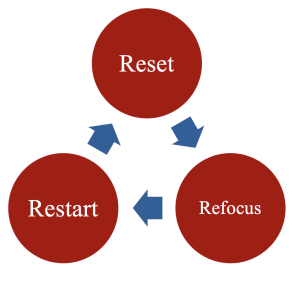
One simple way to think about recovering from a disruption is this little graphic with 3Rs. [Note: I’m not sure who originated this idea as it appears in various forms across the internet.]
When you are hit with a disturbance to your routine:
- Reset – breathe, communicate, release the stress.
- Refocus – look at your to-do list and set new priorities. What must get done today?
- Restart – select the one task from your revised list that you will do first.
Depending on your life, you may have to go through this process multiple times in one day. Alas, life is unpredictable! The key is to never give up. Don’t allow one issue to sidetrack your entire day. Even if it is late in the day, this reframing can be helpful.
* * *
What small disturbances to your routine irritate you the most? How do you recover?


This is a terrific explanation of ways in which our brain works to help us. I also like the examples you shared of things out of our control which often upset our plan/routine/habits. Learning to move away from the problem and instead focus on a solution puts your brain into motion – putting that stress hormone (cortisol) to good use.
“Putting the brain into motion” is a great phrase. I love that! Putting it to work for us, instead of allowing the emotions to take over, is the goal, right?
Love the three r”s – reset, refocus, restart! I am pretty good at the last two but adding in that first one should make it easier to shift when things are not working out as planned. Although I am good about communicating if someone else is involved.
I think I tend to want to push through and rush instead of automatically letting people know I’m running late. I feel guilty when I’m late. But I’ve learned it actually is better to reset those expectations, and often helps me to calm down and refocus.
This is all good stuff, but the phrase that really jumped out for me is “Today’s not going to be perfect but I can still make progress.” Often, when one or more things go wrong, it’s easy to fall into the trap of thinking the day is totally shot, and maybe even the whole week, because what you had planned for today may have to be moved to another day, and so on. Your philosophy is much more positive and likely to bring better results, both in terms of mood and productivity. Thank you!
It’s hard to avoid “all or nothing” thinking. We can get really down when we can’t accomplish what we planned. It gets to me too! But something is still something, so it really works in our favor to keep a positive mindset. No one bats 100% every day.
I love this review of how to get back on track despite interruptions and distractions. Generally, I like to minimize distractions by creating an environment for success. However, distractions happen even in the best of situations. Your refocus with re-prioritizing makes all the difference!
I felt like the entire time when my children were little it was impossible to get a distraction-free environment LOL!